
In August 2025, a landslide in Sudan’s western Darfur region leveled the entire village of Tarsin, killing at least 1,000 people and marking one of the deadliest natural disasters in Sudan’s recent history. Humanitarian first responders were unable to reach those affected for days as flooding continued to block routes and limit movement in the days following the landslide.
The news of the devastation in Tarsin was quickly eclipsed by new atrocities in the months that followed, as the war continued unabated between the Sudanese Armed Forces (SAF) and the Rapid Support Forces (RSF). Amid the conflict, natural disasters also continued to take a toll. Flash floods around Khartoum later in September displaced over 4,000 people and affected nearly 200,000 residents after the Nile River rapidly flooded several villages with minimal warning.
Sudanese communities simultaneously face the threat of war, displacement, and natural disaster, while climate change risks making parts of Sudan uninhabitable in the coming years. Adequately preparing for the threats of climate change must start now, but such efforts are undermined by the continuation of war as well as legacies of uneven development which predate the recent conflict. Understanding the culmination of these past and current dynamics is critical for developing preparedness to current and future climate threats.
Sudan’s growing environmental threats
Sudan is severely threatened by climate change, with increasingly common droughts, floods, and extreme heat expected across the country in the coming years. Climate assessments anticipate substantial future temperature increases in Sudan to be between 1.5° and 3°C. Increases in temperature would make heatwaves more frequent and longer lasting. Such conditions pose particular risks in urban areas which tend to be hotter and where factors like air pollution also threaten public safety. These factors are particularly risky for pregnant women, the elderly, and girls who are at higher risk of dying from extreme heat due to differences in body temperature regulation.
Having access to cool spaces will be critical for keeping people safe amid extreme weather events in the future. Doing so will likely drive up demand for energy and air conditioning unless low tech cooling options are developed. The recent conflict has heavily damaged energy infrastructure in Sudan, leaving millions without electricity and disrupting essential services according to Sudanese energy experts. Such services become a matter of life and death in the event of long-lasting heatwaves and other environmental emergencies.
Periods of droughts are also becoming more prolonged, while periods between droughts are marked by more regular flash flooding. Flooding is common during the rainy season in Sudan every fall, but these events are becoming more intense and risky, particularly amid displacement and disrupted services. In 2025 alone, more than 190,000 people and over 1,700 acres of farmland were affected by seasonal floods around the Nile River. Devastation during to flooding is becoming common year-to-year: In 2020, floods killed over 100 people and affected nearly a third of all Sudan’s cultivated land. Women from some of the affected families reported eating just one small meal per day after losing their crops right before the harvest, highlighting the knock-on effects that extreme weather can have on food security. In 2024, 43 percent of planted areas in Central Darfur were lost due to flooding.
Addressing the way climate change can multiply food insecurity is thus a critical component of ensuring future emergency preparedness in Sudan
Environmental emergencies have wide reaching effects on local food access, and limit prospects for conflict recovery once fighting ceases. Sudan has been ranked as a “hunger hotspot” in 2026 due to the damage to public infrastructure, shortages of agricultural inputs, and the devastating impact of flooding on local crops. Meanwhile, malnutrition rates in Darfur have already reached 70 percent in early January 2026 while el-Fasher remains under siege-like conditions at the time of writing. Addressing the way climate change can multiply food insecurity is thus a critical component of ensuring future emergency preparedness in Sudan.
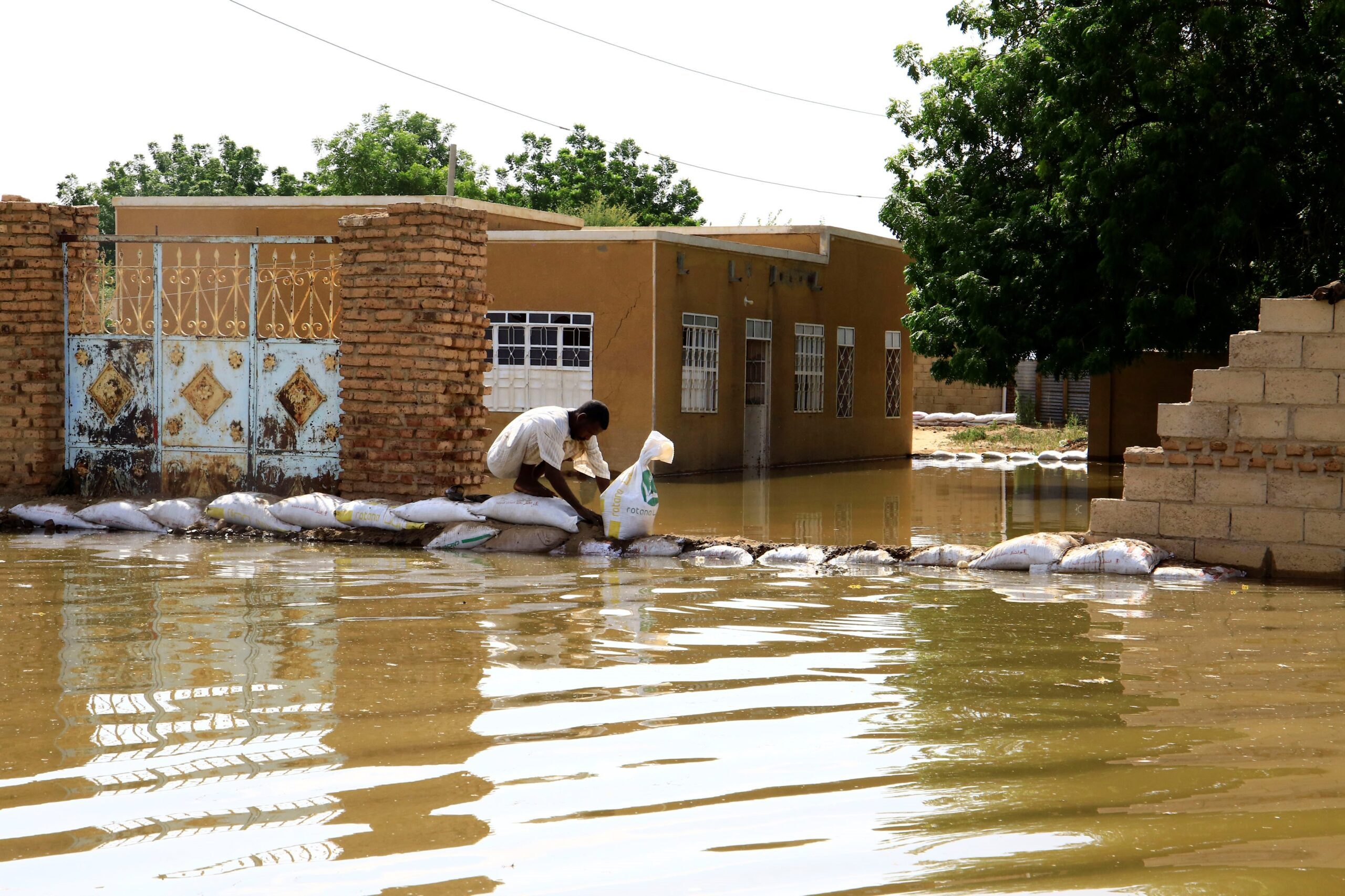
Such emergencies pose specific threats to displaced communities and returnees. Since the current conflict started, nearly a quarter of Sudan’s nine million displaced people reside in informal displacement facilities or open areas, putting them at high risk when natural disasters occur. In Wad Ramli, a village near Khartoum, residents made homemade barriers using sand bags and soil to protect their homes from flooding and slept on higher ground after their village was inundated by flood waters in September 2025. These disasters also threaten recovery prospects once people are finally able to return to their homes. Farmers around Khartoum who lost years of income due to displacement returned only to have their crops for 2025 destroyed by flooding in September.
Legacies of uneven development in Sudan
Climate threats in Sudan are exacerbated by a history of neglect which began long before the current conflict. From the Omar al‑Bashir government from 1989 to 2019, through the transitional period from 2019 to 2021, to the current warring parties, authorities have failed to build adequate infrastructure or prioritize the disaster-management policies needed to mitigate Sudan’s yearly climate threats.
In 2013, Sudan witnessed one of its worst floods in history, which impacted over 500,000 people and destroyed 74,000 homes, with Khartoum sustaining particularly heavy damage. Instead of a coordinated response or adequate preparation, the government feigned surprise claiming that “autumn surprised us with its early arrival,” even though floods have been a longstanding facet of Sudan’s fall months. The phrase was eventually used to mock poor preparation for predictable events and to criticize Bashir’s gross negligence during this period.
Climate threats in Sudan are exacerbated by a history of neglect which began long before the current conflict
In addition to a lack of emergency preparation, infrastructure development under Bashir propped up regime allies while failing to offer holistic public development. The regime was notorious for opaque and often nepotistic public contracting, leading to inconsistent development and weak infrastructure, despite the state spending billions of Sudanese pounds on sewage and drainage projects. Amid rapid urbanization in that same period, residents erected homes around Khartoum on known flood plains, putting them at risk in the absence of a centralized urban planning system or regulatory codes to ensure their safety. Over 1,000 homes in such areas collapsed in 2020 after heavy rains and flooding, killing five people. Despite receiving some warning from the transitional authorities ahead of the 2020 floods, the floods still had devastating effects for three million people.
In addition to deprioritizing emergency preparedness, development policy under the Bashir era exacerbated disparities between rural and urban areas, which will influence who is at highest risk of climate shocks today and in the future. Rural areas have long been politically excluded from central planning and service allocation. This is perhaps most exemplified by longstanding neglect of places like Darfur and Kordofan in exchange for heavy investment in Khartoum. Since at least 2015, rural areas have received about 35 percent less electricity on average than urban areas while Greater Khartoum received nearly half of the country’s national electricity supply before the war. In the context of increasingly frequent and severe heatwaves, these energy inequalities significantly heighten rural populations’ exposure to extreme heat, undermining their capacity to cope with rising temperatures and transforming infrastructural neglect into a critical climate vulnerability.
Regional geopolitics likewise influence natural disaster threats in Sudan. Amid days of heavy rains in September 2025, Ethiopia released water from the Grand Ethiopian Renaissance Dam (GERD) along Sudan’s southeastern border without notifying neighboring governments in Sudan and Egypt. As a result, residents in flood zones were not warned before river levels rapidly rose, overflowing villages including Ad-Damazin, Ar-Roseires, and further north into Egypt. The September floods prolonged longstanding geopolitical tensions after Ethiopia inaugurated the GERD despite objections from Sudan and Egypt in early September 2025, following failed negotiations to identify a diplomatic solution to the dispute.
Recent disasters illustrate the culmination of these factors
All of these factors came together in the tragedy of the Tarsin landslide. The Marra Mountains region has long suffered from a lack of infrastructure and extremely rugged roads, with some villages accessible only through long journeys by foot or on horseback. The region has also been cut off from other parts of the country since the war; for instance, the vital Nierteti–Zalingei road in the area was closed for five months in 2025 as a result of clashes between the RSF and SAF-aligned groups.
Even before the landslide, these conditions severely limited people’s access to basic services. Humanitarian groups had reportedly withdrawn from areas around the Marra Mountains in the months leading up to the landslide and aid groups had described areas around Tarsin as being cut off from humanitarian support. In the end, only five aid organizations were able to reach Tarsin in the landslide’s aftermath, carrying aid by foot and on donkeys.
In Khartoum, authorities failed to adequately warn communities about impending flood risks even after weeks of rain. Authorities finally issued a flood warning on September 22, 2025, after villages in al-Jazirah had already flooded the week prior. The warning issued on social media was notably vague, noting areas at risk of floods but offering little information about necessary precautions or how long flooding forecasts would last. The message was too little too late, prompting outcry from residents.
Legacies of weak infrastructure and patchy development have been compounded by the recent war, making Sudanese communities more at risk of environmental emergencies and climate change today and in the future
Legacies of weak infrastructure and patchy development have been compounded by the recent war, making Sudanese communities more at risk of environmental emergencies and climate change today and in the future. For instance, by 2025, up to 40 percent of Sudan’s energy generation capacity had been lost due to the war, disrupting essential services. Adequate emergency preparedness requires equitable development and recovery policies which address the inequalities created from past decisions and war damage; this cannot be addressed through short-term or one-off programs, but instead requires sustained governance capacity and stable financing. In parallel, climate resilience cannot be developed overnight, but instead requires long-term planning and investment in order to enable safer infrastructure before emergencies strike, and to help facilitate proper coordination and messaging once they do.
What is climate resilience amid war and recovery?
Climate change, war, governance, and economic recovery are increasingly intertwined in Sudan, and thus cannot be addressed as separate issues. Even areas far from frontlines will be threatened by seasonal flooding, poor infrastructure, and energy and telecommunications blackouts in the coming years. Conditions will be perhaps most dire for communities residing in areas controlled by the RSF and along frontlines, as they are already cut off from basic services and emergency aid. The devastating effects of disasters in 2025 reveal the urgent need for a new approach to emergency response in conflict-affected contexts.
In the immediate term, humanitarian responders can begin preparing for droughts and floods that are likely to occur in 2026. In the longer term, climate risks cannot be addressed solely through humanitarian or mutual aid systems, but instead require a coordinated, country-wide resilience strategy to enable recovery and infrastructure improvement across urban and rural areas alike. Such a strategy would need to address the criticality of energy and agriculture sectors in particular for enabling resilience to future climate shocks. Embedding environmental considerations into conflict recovery programs will help limit the effects of some future disasters, and now is the time to start such planning.
Taken from The Tahrir Institute for Middle East Policy, written by Haley Schuler-McCoin and Mahitab Mahgoub.











اترك تعليقاً