
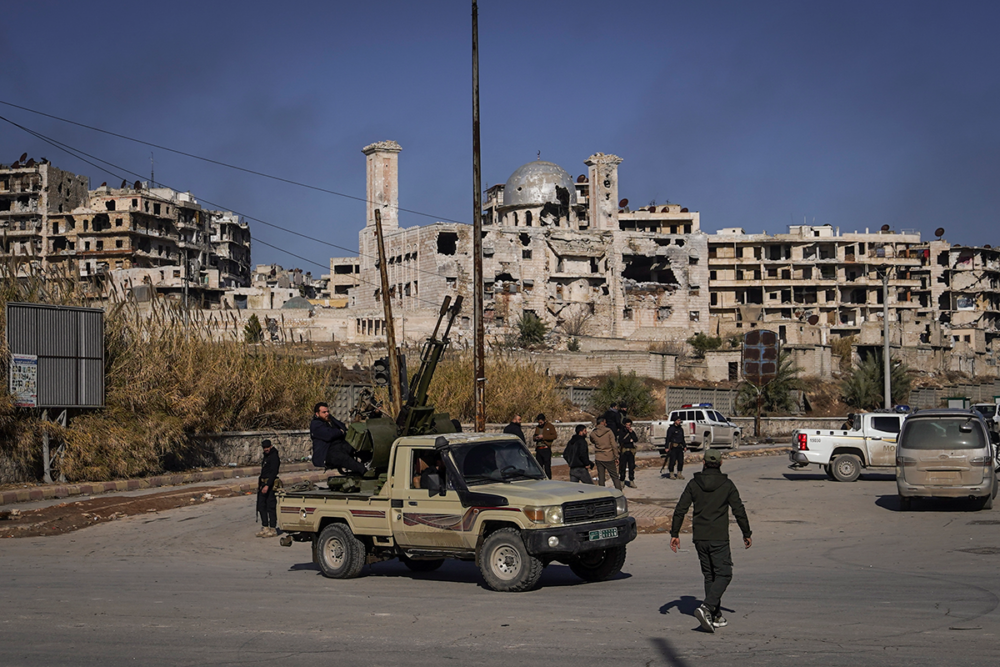
After months of building tensions, full-blown hostilities erupted between Syria’s transitional government and militia fighters linked to the Syrian Democratic Forces (SDF) in Aleppo on January 6. Through four days of fighting, government forces have now assumed full control of Syria’s second city, after expelling SDF-linked forces from its northwestern districts. Challenging negotiations, mediated by the United States, have continued for months, but the SDF’s commitment to integrate into the state has not been implemented. This latest conflict and the prospect for it to expand into new areas underlines the potentially existential challenge faced by Syria’s transition, should it fail to assimilate rival non-state actors under a broader transitional authority.
A new government emerges in Damascus
When Bashar al-Assad’s regime collapsed in December 2024, Syria fell to armed opposition groups that had fought the regime for more than a decade. But the interim government that swiftly took shape in the capital, Damascus, never attained control of all of Syria. To this day, approximately 25% of the country remains under the authority of the SDF, a Kurdish-dominated militia that had been the primary partner of the US-led Global Coalition to Defeat ISIS since 2015. The SDF and the armed factions that assumed control in Damascus also have more than a decade of tensions and hostilities behind them, making the line drawn between them in northeastern Syria particularly thick.
Having cooperated so closely with the SDF for nearly 10 years, the US military faced a predicament after Assad fell from power and a new government emerged. For years, the SDF had proven a loyal and dependable local partner, but at the end of the day, it was a non-state actor, whose Kurdish base had long been a trigger for wider instability, both inside Syria and, to an extent, beyond it. The prospect of working with a sovereign government that would hopefully one day be representative of all of Syria was an enticing prospect — rightly so, notwithstanding the challenges.
The US military was therefore the first to make contact with Syria’s new government, just 24 hours after Assad’s fall. Ten days later, on December 19, 2024, senior US military officers were in Damascus, joining the first diplomatic engagement with Syria’s transitional president, Ahmed al-Sharaa. By January 2025, a clear consensus had emerged that the SDF needed to be guided toward integration into the new, emerging Syrian state — both to protect the achievements and experience gained by the SDF as well as to help consolidate Syria’s transition and put it on a path toward stability.
Three months later, on March 10, 2025, SDF leader Mazloum Abdi was flown on a US helicopter to Damascus to sign an agreement with President Sharaa. At the core of that framework agreement was an SDF acceptance that following a process of negotiations, it would dissolve and integrate into the state. Behind the scenes, the US would serve as mediator while Turkey, which had long harbored and acted upon its hostility to the SDF over the group’s links to the Kurdistan Workers’ Party (PKK), promised to stand back and provide space for negotiations. The US government set an initial deadline of August 2025 for the deal’s implementation, which then stretched to October, and finally to December 2025.
All of the deadlines came and went, as round upon round of talks ended with positive readouts but zero implementation. “So far, it seems that they’re focused on wasting time without any real will to integrate,” one senior Syrian government source told the author, describing their SDF counterparts and speaking on the condition of anonymity.
It is not hard to understand why the SDF, or elements within it, has resisted the idea of ceding everything gained since the movement’s formation a decade ago. For years, the international community considered Ahmed al-Sharaa a terrorist, while celebrating the accomplishments and values of the SDF. When Assad fell, that dynamic appeared to flip on its head — incomprehensibly, from the SDF’s perspective. Then came large-scale massacres in Syria’s Alawite-majority coastal region in March and the Druze-majority governorate of Suwayda in July 2025 — brief but horrifically deadly chapters of violence that suggested a grim fate for Syria’s minorities. With a quarter of Syria under its control, home to as much as 80% of the country’s energy resources, the SDF has a lot to lose by ceding to integration.
Yet despite this reality, the viability of a political movement based on an ideology seeking some form of autonomy was lost when Assad fell. Soon after the change of government in December 2024, the SDF’s lack of popularity across Syria was palpable. Moreover, with the SDF’s greatest champion, the US government, choosing to prioritize investment in the fledgling Syrian transitional government, going as far as to bring it into the Global Coalition, the winds are clearly blowing in a direction in which the SDF’s integration into the state needs to happen — for Syria’s sake, as well as the SDF’s.
Tensions come to a head in Aleppo
As 2026 began, tensions were sky high, and small-scale tit-for-tat clashes were becoming a frequent occurrence along government-SDF front lines. Then on the night of January 5, two SDF suicide drones were directed to strike government police vehicles in the countryside east of Aleppo city, leaving police and civilian casualties.
Despite the SDF’s best efforts to distance itself from the incident — at one point describing it as a car accident, even though the two vehicles clearly had holes blown through their roofs — the damage was done. Heavy clashes swiftly erupted nearby, which then spread to Aleppo, where SDF-linked fighters remained in de facto control of two city districts: Sheikh Maqsoud and al-Ashrafiyeh. From there, Kurdish fighters fired into heavily populated government-held districts, using mortars, rocket-propelled grenades, and heavy anti-aircraft machine guns — even though the SDF had previously agreed to withdraw all of its military forces and heavy weaponry from the area under a April 2025 deal, leaving behind only lightly armed local security units known as Asayish. SDF fire triggered government retaliatory shelling, locking in hostilities.
From January 6 to 10, Sheikh Maqsoud and al-Ashrafiyeh became a new front line in Syria’s conflict, as the government in Damascus declared the area a military zone run by “outlaws.” By the evening of January 8, as government special forces took control of al-Ashrafiyeh, US-mediated talks secured a cease-fire in exchange for an SDF agreement to withdraw its fighters from their positions in Sheikh Maqsoud to its region of control in northeastern Syria. Per the agreement signed off on by SDF leader Mazloum Abdi, the withdrawal was to take place between 3 am and 9 am on the morning of January 9.
As the sun rose that morning and buses arrived to transport hundreds of armed men and women east, the SDF’s militia fighters publicly rebuffed the deal and insisted they would continue their resistance. At one evacuation point, government forces were attacked, leaving three soldiers dead. US-mediated negotiations swiftly resumed and a new evacuation deal was reached that afternoon — but it was once again rejected by the SDF’s fighters on the ground. That night, government special forces launched an offensive into Sheikh Maqsoud, where at least five Asayish suicide bombings attempted to stem the advance.
By 3 pm the next day, January 10, the government had taken control of Sheikh Maqsoud, and several hundred SDF-linked fighters were bussed out of the city and into SDF-held areas to the east.
But as the evacuations were ongoing, SDF forces in rural eastern Aleppo launched at least 13 suicide drones toward Aleppo city. Six were shot down but seven reached their targets. One struck Aleppo City Hall during a press conference involving two government ministers — Syrian-Canadian Christian Hind Kabawat and British-educated Hamza al-Mustafa — and Aleppo’s governor, Azzam al-Gharib. Another landed outside a mosque shortly after Minister Kabawat had departed after visiting displaced people. Others struck residential buildings and a police station. That evening, the SDF closed off Aleppo’s primary source of drinking water at the Babri Pumping Station, but US pressure forced them to turn supplies back on hours later.
By the close of hostilities on January 10, at least 24 civilians و 39 government security forces were confirmed dead, and 129 other people injured. While approximately 148,000 local residents were displaced, a sizeable proportion have already returned to their homes. But in Sheikh Maqsoud, the pace of returns has been slowed by the large number of explosive devices left behind by SDF-linked fighters — including booby traps inside residential buildings, in a mosque (including a bomb hidden under a Quran), in a hospital, in piles of trash on the street, and even inside abandoned weapons.
Takeaways from the fighting
On review, Syrian government forces have clearly learned lessons from the previous spikes in violence in 2025, which were marked by chaos and criminal behavior. While online accounts claim to have documented at least one potential extrajudicial execution — which should be expeditiously investigated, and those responsible prosecuted — that pales in comparison to the scenes witnessed on the Syrian coast in March 2025 and in Suwayda in July 2025. In Aleppo, the Ministry of Defense published 15 satellite maps over 48 hours identifying military targets and warning civilians to avoid them, taking a page out of Israel’s book. As areas were taken under control, Syria’s government was swift to surge in humanitarian assistance and personnel to repair electricity, water, and transport services. Government behavior was by no means perfect, but it was a marked improvement.
Facing growing military pressure, the SDF turned increasingly to disinformation in an attempt to shape public narratives, especially abroad. To take one example, on January 9, the Ministry of Defense put out a map identifying a military target in Sheikh Maqsoud. When the building was struck several hours later, it triggered over 30 minutes of secondary explosions, suggesting it had detonated large quantities of ammunition. In the span of six hours, from the initial Ministry of Defense announcement to the public release of the strike’s outcome, the SDF’s official spokesman described the target first as a hospital, then as a civilian house, and finally as a residential area, labeling the strike a symbol of Damascus’ “systematic war of annihilation.” On January 10, imagery emerged from the scene, showing it had been a large military base full of equipment, including vehicles, heavy machine guns, and significant quantities of ammunition, as well as mortars, grenades, and landmines.
Above all else though, the recent hostilities in Aleppo were a clear and unfortunate reminder of the consequences of Syria’s failure to reunite following Assad’s fall. Despite signing the framework agreement in March 2025, the SDF has taken no meaningful steps to implement what it promised to do. While the government in Damascus has been a tough negotiator, US and other external mediators are under no illusions about the source of the problem. “It’s become increasingly clear this year that the SDF is not as cohesive a movement as we had thought,” one senior European diplomat told the author in December 2025.
Why negotiations have come up short
In the talks themselves, SDF delegation leaders Mazloum Abdi and Ilham Ahmed have engaged pragmatically, but agreements made at the table are then taken back to SDF territory for internal consultation. “It’s the cadres that are the real problem,” as one US military source told the author on condition of anonymity, referring to SDF members whose true loyalty lies with the transnational militant movement, the PKK, which the US government has designated as a terrorist organization. “Listen, Damascus have been hard negotiators, there’s no question, but in terms of blocking actual movement, the blame for that is the SDF’s alone,” said another US source.
Indeed, it is hard to fathom why a comprehensive integration deal has not yet been announced, as its core structure was agreed months ago in October. According to conversations with senior officials who are involved in or directly privy to the negotiations from the US, Turkey, and Europe, as well as Syria itself, both Damascus and the SDF have already agreed to the following:
- Full Kurdish civil rights, to be reflected in a constitutional reform process;
- Kurdish as a national language, to be reflected in a constitutional reform process;
- Three defense ministry divisions for SDF personnel, based in northeastern Syria;
- One dedicated defense ministry regiment for the SDF’s female Women’s Protection Units (YPJ) personnel;
- Asayish integration into the Ministry of Interior’s Public Security Force;
- Senior posts within the defense and interior ministries; and
- Ministerial positions, as part of a cabinet reshuffle.
But despite an agreement on the above having been sealed in October 2025, the SDF subsequently pushed for new deal-breaking conditions, including:
- No defense ministry or interior ministry personnel to be permitted access to northeastern Syria;
- Independent process of recruitment for SDF-origin military and security forces in northeastern Syria;
- SDF-origin military divisions to control border forces (with areas of Turkey and Iraq, bordering northeastern Syria); and
- SDF-origin personnel to coordinate defense ministry communications.
Outlook for talks moving forward
For now, the prospect of hostilities continuing along a new front are very real, with the front line at Deir Hafer in eastern Aleppo being the epicenter of sky-high tensions and a mutual military buildup. The SDF destroyed two key bridges linking government areas with its territory late on January 12, and the Ministry of Defense in Damascus declared Deir Hafer and its surrounding areas “closed military zones” on January 13, suggesting escalation was imminent. Should that occur, major conflict will be all but inevitable, as Arab-majority areas of SDF control will likely look to rise up in an attempt to eventually squeeze the SDF into a smaller pocket of Syria’s northeast.
The US and all interested parties need to urgently make clear to both sides that talks must resume and a deal must be expeditiously made and implemented. The fate of Syria’s transition may rest on the outcome of this stand-off. “We’re at a crossroads,” a senior government source in Damascus told the author. “We can’t continue to allow this process to prolong, but we don’t want a military solution that will turn the YPG into an insurgency in the long run,” they said.
Some within the US government have proposed moving talks to a third country and rather than running relatively brief hours-long sessions, to sustain them for however many days are required to seal a comprehensive deal. But that could pose a challenge for the SDF, whose internal divisions have emerged more clearly in recent months. While some within the SDF appear determined to stall in the hope that Damascus will eventually lose international favor, others within the group seem to have calculated that continuing talks but refusing to commit is the best way to sustain SDF unity.
That may be a miscalculation though, as the Arab communities that dominate considerable portions of SDF territory are growing increasingly restless. Tribal leaders within SDF areas have been frequent visitors to Damascus in recent months, occasionally publicly, but most often in private. A window into the consequences of this tribal outreach came to the fore on January 8, when Baggara tribal militiamen within SDF-linked forces in al-Ashrafiyeh turned their guns on their Kurdish colleagues, paving the way for government special forces to launch their offensive. A similar scenario is waiting in the shadows in SDF-held Deir ez-Zor, as well as areas of Raqqa and southern Hasakeh.
As a senior official in US Central Command made clear when speaking to the author, the challenge now is urgent: “The end of violence and the continuation of integration talks are critical to the security and future of Syria. The recent events in Aleppo exemplify the urgency of both sides coming together for the good of Syria and working out the details of the integration plan that was agreed on in March 2025 and refined in October 2025. … A new Syria must emerge from the ashes of war, uniting all groups, ethnicities, and factions that bore the brunt of the fighting.”
Charles Lister is a senior fellow and the director of the Syria Initiative at the Middle East Institute, where he focuses on Syria, terrorism, and insurgency across the Levant.
Photo by Adri Salido/Getty Images
اترك تعليقاً