
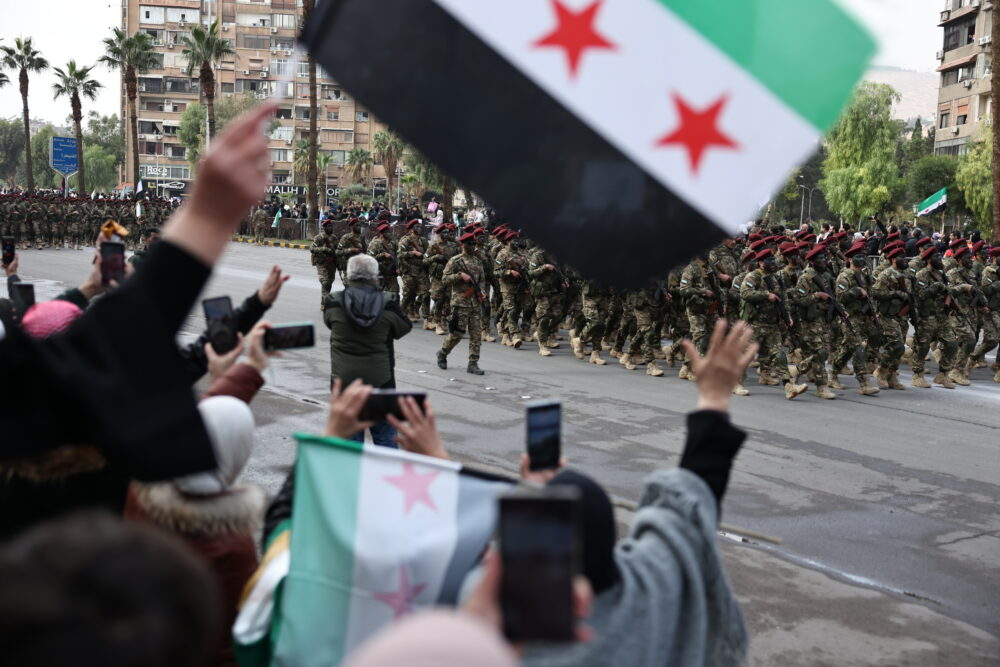
The second year of Syria’s transition faced a rocky start this January, with large-scale conflict erupting in the northeast between the government and the Kurdish-dominated Syrian Democratic Forces (SDF). Despite nine months of negotiations mediated by the United States, the lack of any implemented agreement to successfully integrate the SDF into the state made hostilities all but inevitable. As it happened, government forces advanced rapidly, securing control of all of Aleppo City between January 6 and 10 and then 80% of SDF territory in northeastern Syria between January 17 and 19. In two dramatic phases of hostility, the SDF’s viability as a long-term political and military force effectively ended.
Since then, a US-mediated cease-fire on January 20 gave way to a comprehensive deal on January 30 to fully integrate the SDF and its armed and civilian entities into the state. That put an end to the fighting and paved a path toward a months-long process of integration. To be sure, there is a long way to go and many potential bumps along the road. And yet, early indications suggest that both sides can demonstrate the kind of pragmatism, flexibility, patience, and compromise required to reunite two long-divided regions of the country and contribute to Syria’s recovery.
A year of declining violence
While three weeks of government-SDF fighting left more than 300* people dead (almost all of them combatants), its resolution brings back a reality that has been clear for months: Syria is actually stabilizing. In fact, the overall level of violence across the country has been on an increasingly sharp decline, as illustrated by data collected and analyzed by this author — with an average of 134 violent deaths recorded per week in the first third of 2025, an average of 94 in the second third of 2025, and an average of 25 in the final third of the year. In fact, five of the last eight weeks of 2025 saw fewer than 20 killed nationwide. Notwithstanding the recent and temporary uptick in January, violence has declined further since, with a weekly average of 11 deaths across the country.
Syria’s transition still faces a formidable array of challenges — from the economy, reconstruction, transitional justice and accountability, refugee returns, and geopolitical tensions with Israel. However, a steady and significant decline in violence offers perhaps the most encouraging and consequential metric. Domestically, the transitional government has taken steps to tackle the biggest contributors to violence at home.
The government’s response to sectarian violence
Following two brief but horrific bouts of violence — on the Mediterranean Coast in March and in the southern governorate of Suwayda in July — the government was widely accused of losing control and being both complicit in and failing to prevent mass killings targeting minority communities. In their wake, the Ministry of Defense (which was formed entirely from opposition armed groups) was pulled back and away from domestic security challenges, and the Syrian government launched intensive efforts to engage tribes to place them more directly under state control. Meanwhile, the Ministry of Interior launched large-scale local recruitment campaigns across the country aimed at creating and deploying local security and police into their own communities. This has helped enormously in bridging gaps of trust, improving local awareness, and enhancing the ability to mitigate localized security threats.
Tackling vigilantism
Throughout 2025, the most consistent and significant contributor to incidences of violence across Syria was vigilantism and targeted revenge killings fueled by years and sometimes even decades of unresolved grievances. Most attacks targeted people formerly associated with Bashar al-Assad’s regime, by profession, family, or religious group. From January to October 2025, an average of 23 vigilante killings were confirmed every week across Syria, this author has found. The sheer intensity of such targeted killings threatened to pull Syria’s already fragile social fabric apart. Yet from October to the end of 2025, the rate of vigilantism declined 70% to seven deaths per week; and so far in 2026, only three deaths have been confirmed in six weeks. The almost total cessation of vigilante killings in Syria is largely the consequence of actions taken by the Ministry of Interior, which has quietly detained dozens of perpetrators in recent months.
Solving the unexploded ordnance threat
Beyond vigilantism, another dominant contributor to violent deaths in Syria has been unexploded landmines and other ordnance left over from years of conflict. Between January and September 2025, 15 people were killed every week by unexploded ordnance (UXO) across Syria — making it the world’s largest UXO challenge by a significant margin and accounting for a third of UXO casualties worldwide. And yet, the author has found, from September through to the end of 2025, that rate fell 73% to 4 deaths per week. While tens of thousands of landmines and other munitions have been removed in recent months, this sharp decline in UXO incidence and casualties is primarily the result of intensive efforts by Syria’s Defense and Emergency Ministries to map out UXO-affected areas and educate people to avoid them.
Fighting Islamic State terrorism
The fall of Assad’s regime and the emergence of a new transitional system in Syria also resulted in a 50% decline in Islamic State (ISIS) attacks in 2025 compared to 2024, and a 76% decline in casualties caused by ISIS attacks. For many years, ISIS depended heavily on Assad’s regime — both for its inability and at times lack of will to meaningfully challenge the group, and for the fact that Assad’s persistence and continued brutality created ripe conditions for ISIS to recruit. With Assad gone, ISIS has lost what it relied upon most to justify its existence and now faces a government determined to defeat it, as the newest member of the US-led coalition.
Moreover, of the 348 ISIS attacks confirmed in 2025, 89% took place in areas controlled by the SDF, where ISIS sought to exploit deep fissures between a Kurdish-dominated militia and the Arab-majority regions over which it ruled. With the SDF now integrating into the state, ISIS will be forced to adapt even further. In fact, ISIS has conducted only two attacks in the last three weeks, marking a sudden 93% decline in operational tempo compared to the six months prior. While the terror group will almost certainly recover, the conditions it now faces in Syria present a potentially existential challenge.
A still long road ahead for Damascus — and how Washington can help
On a security level, there are clear data-driven indications that Syria is on a path of significant stabilization. However, serious challenges remain, and the country is by no means out of the woods or predestined to achieve full stability anytime soon. Domestically, the central challenge of reunifying Syria, achieving tangible progress in transitional justice and accountability, while building more stable relationships of trust with minorities will likely define the sustainability of the transition itself.
Beyond these strictly internal domestic security challenges, Syria’s transition must also find a path toward resolving issues with more regional characteristics. While the January 30 SDF integration agreement was positive news, and the early phases of its implementation have been encouraging, the process has a long way to go. Many challenges remain regarding the practicalities of actually integrating tens of thousands of SDF military, security, and civilian personnel into the state and under government authority. The fate of hundreds, if not thousands of prisoners held by both sides will need to be resolved in order to avoid already existing protests turning to violent recriminations. Full integration will take most of 2026 to implement; and as that process plays out, the US should utilize its presence on the ground in Syria to monitor, mediate and help guide the process forward. A premature withdrawal of US forces, before this integration has been achieved, would be a serious mistake.
In addition to integrating the SDF, Syria faces at least three other domestic challenges with broader regional connections, including reintegrating the Druze-majority governorate of Suwayda, sealing some form of security and political agreement with Israel, and dealing a decisive defeat to ISIS. Each of these issues, if left unresolved, has the potential to tear down the transition and trigger major conflict; and solutions to all three of them will require concerted US help. For now, the US military, intelligence, and diplomatic communities are all engaged in activities aimed at tackling them, but solutions will require time and persistent effort. To achieve a Syrian-Israeli accord, pressure from President Donald Trump himself will likely prove decisive, and a deal on that will open a path to resolve the Suwayda challenge.
On ISIS, the consolidation of a fledgling US-Syrian bilateral security relationship is crucial. Since the spring of 2025, the relationship — channeled through Syria’s Ministry of Interior and General Intelligence Directorate — has expanded by leaps and bounds. But with the SDF integrating into the state, US military forces are now engaged in another drawdown in northeastern Syria. America’s investment in the counterterrorism fight in Syria remains of vital importance, but its defining characteristics must adapt to new circumstances. Ongoing efforts to locate a compound in Damascus for military and intelligence personnel and to establish a permanent diplomatic presence in Syria’s capital should be expedited.
Ultimately, Syria’s transition is fraught with complexity and challenge, and the road ahead will be far from smooth. But if the metrics of violence are anything to go by, there is cause for guarded optimism — and all the more reason to double down on supporting a transition whose success would create powerful positive ripple effects across the wider Middle East region.
Charles Lister is Senior Fellow at the Middle East Institute and heads MEI’s Syria Initiative.
Photo by Chris McGrath/Getty Images
Note
* This estimate is based on casualty figures compiled and analyzed by this author, published in the separate publication Syria Weekly. Syria Weekly regularly monitors and collects data on every violent incident across Syria, as reported and cross-verified by at least two vetted and reputable sources, including mainstream news outlets, social media, and direct official sources.







اترك تعليقاً