
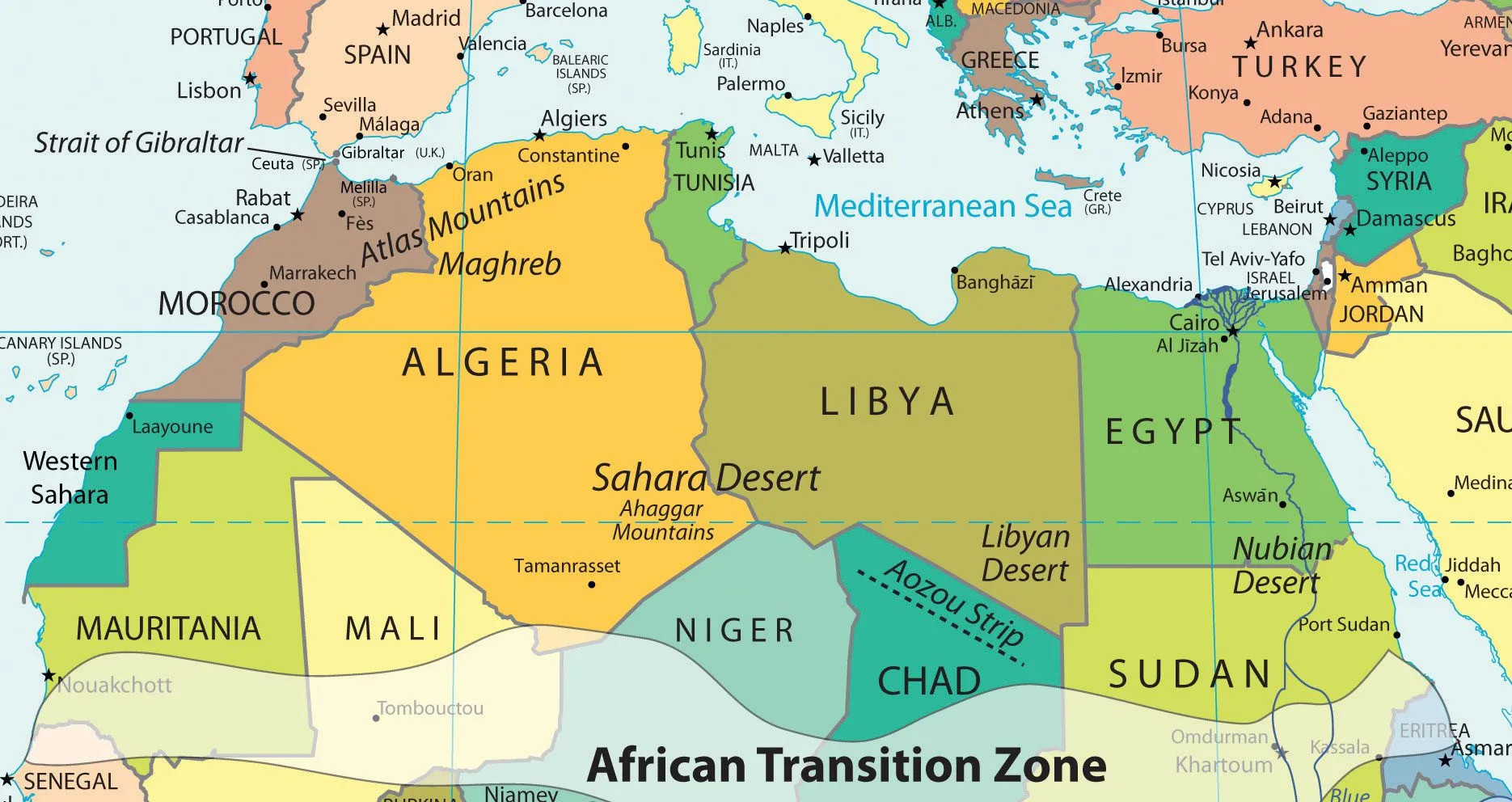
North Africa entered 2026 with cautious economic momentum. Combined GDP growth across Morocco, Egypt, Algeria, Tunisia, Libya, and Mauritania had reached approximately 4 percent in 2025, outperforming both sub-Saharan Africa and the broader Middle East. Egypt and Morocco were driving much of that expansion, with Morocco’s automotive exports exceeding $14 billion annually and Egypt attracting renewed foreign investment following a series of IMF-backed structural reforms. The International Monetary Fund projected the region’s growth would accelerate further in 2026. Then, on February 28, the United States and Israel launched coordinated strikes on Iran, and the economic assumptions underpinning North Africa’s trajectory began to fracture.
Egypt: The Most Exposed Economy
Egypt is bearing the heaviest economic burden of any North African state. The country is a net oil importer, depends on imports for roughly one-third of its natural gas supply, and relies on the Suez Canal as a critical source of foreign currency. The war has hit all three pressure points simultaneously. Israel suspended natural gas supplies from its eastern Mediterranean fields immediately after the conflict began. Global oil prices surged past $120 per barrel following Iran’s closure of the Strait of Hormuz. And major shipping lines, including Maersk and CMA CGM, rerouted traffic around the Cape of Good Hope, draining the canal of the revenue recovery Cairo had spent two years working toward.
President Abdel Fattah el-Sisi described the economy as being in a state of near-emergency, citing a cumulative $10 billion decline in Suez Canal receipts since 2020. The government raised fuel prices by an average of 17 percent in early March, a politically sensitive move in a country where a third of the population lives below the poverty line. Inflation jumped from 10 percent in January to 11.5 percent in February. The cost of meat has since risen 25 percent, with fruit and vegetables up 15 to 30 percent in Cairo’s markets. Foreign investors pulled approximately $1.12 billion from government debt instruments, pushing the Egyptian pound toward 48 per US dollar.
Morocco: Relative Resilience, Real Vulnerabilities
Morocco enters the crisis from a stronger structural position. Decades of incremental reform have embedded the country into European manufacturing value chains, particularly in automotive and aerospace. Renewable energy capacity ranks among the largest in Africa, and industrial zones tied to the Tangier Med port have attracted consistent foreign direct investment. Growth near 4 percent reflects a system that compounds gains steadily rather than depending on commodity cycles.
Yet Morocco is not insulated from the current shock. The country imports most of its energy, and the surge in global oil prices feeds directly into production costs, transportation, and consumer prices. The OCP Group, Morocco’s state-owned phosphate giant, issued bonds in March to finance expansion, but the oil price surge has raised input costs for fertiliser production, the sector on which OCP’s margins depend. The World Economic Forum warned that poorer fuel- and food-importing states in Africa face the shock most acutely, in the form of higher household prices, fiscal strain, and a greater risk of social unrest.
Algeria and Libya: The Hydrocarbon Trap
Algeria and Libya remain structurally dependent on oil and gas revenue, a vulnerability that cuts in two directions during a supply crisis. Higher global prices should benefit exporters in theory. In practice, the disruption to Gulf shipping routes has created volatility that undermines long-term planning, while neither country possesses the institutional capacity to convert a windfall into durable growth. Algeria’s economy remains largely closed to foreign investment, with bureaucratic barriers discouraging the private sector activity needed to absorb its large youth population. Libya, still split between two rival administrations, cannot coordinate a unified fiscal response to any external shock.
Tunisia tells a different story. Growth has barely exceeded 1 percent, real incomes continue to fall, and the government has not enacted the reforms that might release IMF support. Moody’s upgraded Tunisia’s sovereign debt rating in early 2025, but these are narrow gains against a backdrop of deep fiscal and political constraint.
A Region Splitting Apart
The Iran war has accelerated a divergence that was already visible before the first missile was fired. North Africa is splitting into reform-capable economies and rent-dependent ones. Egypt and Morocco, for all their vulnerabilities, have built institutional capacity, diversified their export bases, and attracted external financing. Algeria, Libya, Tunisia, and Mauritania have not. The Atlantic Council noted that Egypt’s external position is correlated to regional instability, and that simultaneous shocks across remittances, tourism, and oil prices can create exponential stress. The same observation applies, in varying degrees, across the entire subregion.
North Africa’s economic model was always thinner than the headline growth figures suggested. The Iran conflict has confirmed how quickly external shocks can erode the foundations beneath that progress. When oil prices spike, currencies weaken, and shipping routes close, the gap between macroeconomic performance and lived economic reality widens fast. The choices made in Cairo, Rabat, Algiers, Tunis, and Tripoli in the coming months will determine whether this crisis becomes a temporary disruption or the beginning of a deeper structural unravelling.




Leave a Reply