
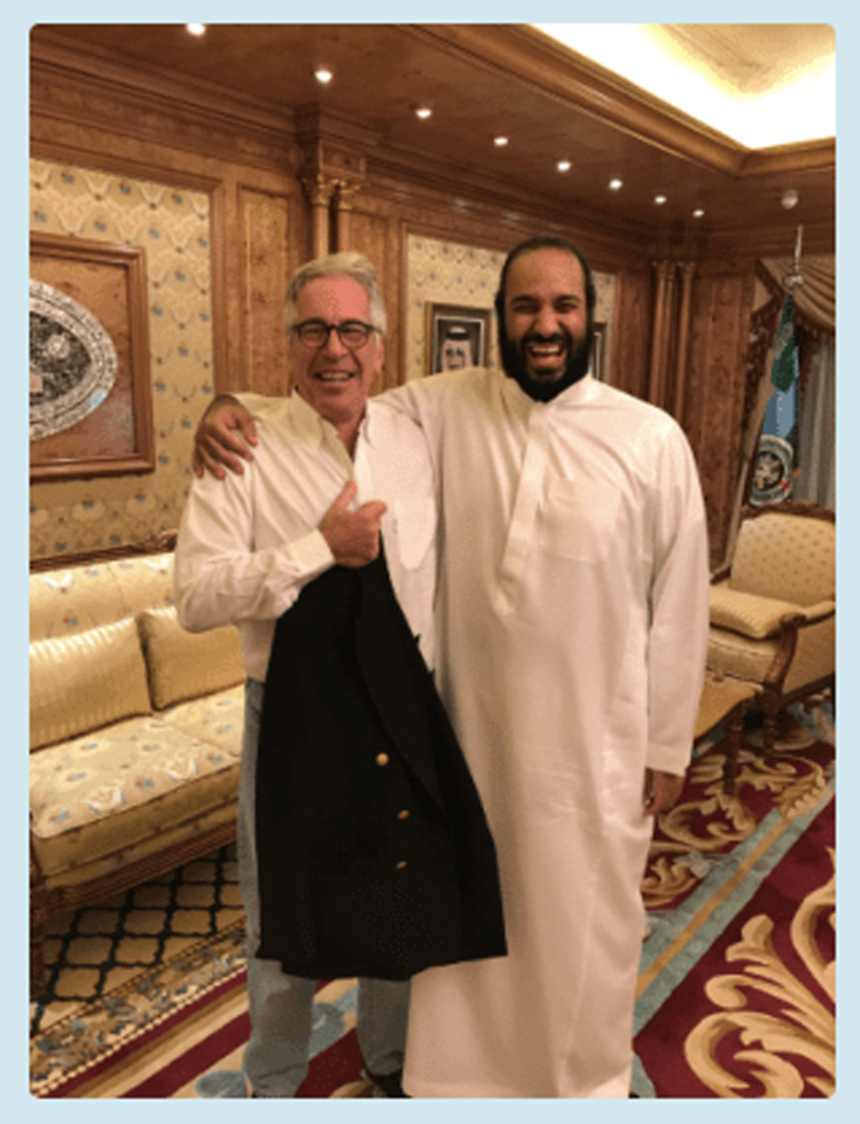
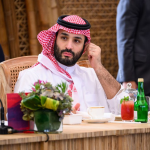
There is a photograph sitting prominently framed on the wall of Jeffrey Epstein’s Manhattan townhouse, a convicted pedophile’s home, and it showed Crown Prince Mohammed bin Salman at his royal court next to Jeffrey Epstein. We know this because when federal agents searched the property after Epstein’s 2019 arrest, they catalogued it. We know, too, that in the same safe where investigators searched, they found Jeffrey Epsteins expired Austrian passport, with his home address listed as being in Saudi Arabia. In late 2016, Epstein flew his private Gulfstream G550 alone from Paris to Riyadh and came back from said visit with a lavish gift directly from MBS, a Bedouin tent, “carpets and all.” And when Saudi Arabia’s Ritz-Carlton purge of 2017 upended the kingdom’s elite, Epstein wrote to a New York Times reporter: “All. With gods help ;)” asked whether his “Saudi friends” had survived.
It is ironic that the man who presents himself as Islam’s guardian and the architect of a new, “moderate Islam” had his portrait on the wall of one of history’s most notorious sex traffickers. The question every Muslim should be asking is how did it end up there, and what does it mean?
The Epstein files, released by the US Department of Justice in early 2026, have begun to sketch an answer. A Saudi Royal Court adviser, Raafat Al-Sabbagh, was visiting Epstein’s townhouse the very moment that MBS was appointed as crown prince in 2017. Mr. Al-Sabbagh warmly wrote to Epstein after his visit about his “beautiful house, specially the (GYM) area.” Clearly the use of (GYM) is most likely a euphemism for one of the many services that Epstein provided to clients, and friends alike to the pizzagate. Intelligence on MBS’s US travel schedule was being relayed between Epstein and the Royal Court. And a piece of the Kiswa — the sacred cloth of the Kaaba itself, handled by tens of millions of pilgrims, soaked in tears and prayers — was shipped as a gift to Epstein’s Florida home in 2017, years after his federal sex conviction. The holiest material in Islam. Sent to a child sex trafficker. It is also safe to assume that the holiest material in Islam is not moved without approval of someone extremely high up in the Kingdom of Saudi Arabia.
To understand how we arrived here, we need to understand the foundation at the heart of the Saudi state, a literal blood deal that is over three centuries old and one that has not only shaped Saudi Arabia but, through oil wealth and deliberate policy, the Islamic world as a whole from Khartoum to Karachi.
In the 18th century, Muhammad ibn Saud, a minor tribal chieftain in the Najd, made an alliance with a radical preacher named Muhammad ibn Abd al-Wahhab. The deal was simple and brutal: al-Wahhab would supply religious legitimacy in return the ibn Saud family would supply military force. The cleric would tell the people that God commanded their obedience to the ruler; the ruler would enforce the cleric’s interpretation of God’s law on the people. Power and piety fused — not because they naturally belong together, but because each needed the other to survive.
That deal is the DNA of the modern Saudi state and would lead to the creation of Wahabism. Every restriction imposed on ordinary Saudis, the guardianship system, the religious police, the flogging of poets and the jailing of feminists, drew its legitimacy from this arrangement. The people must submit to God. And the men who speak for God happen to be the men who hold power and even then those men of God have to align with MBS and the kingdom or risk being called a traitor.
MBS has updated the deal for the 21st century without changing its essential logic. He has loosened some social restrictions while simultaneously tightening political control. The religious establishment has been subordinated not because MBS believes in liberalism, but because he no longer needs the clerics to legitimize the rule of the monarchy. He is the source of legitimacy now. MBS is trying to replace religion with the kingdoms’ 2030 vision. But the underlying principle, that the people exist to serve the project of the rulers, and that dissent is heresy remains intact. Any cleric that does not further MBS’ agenda is eliminated while those who advance MBS agenda seem to magically flourish.
What the Kingdom did domestically in weaponizing Islam to further the goals of the ruling class it also started exporting. On an absurd scale only achieved through their unlimited oil money.
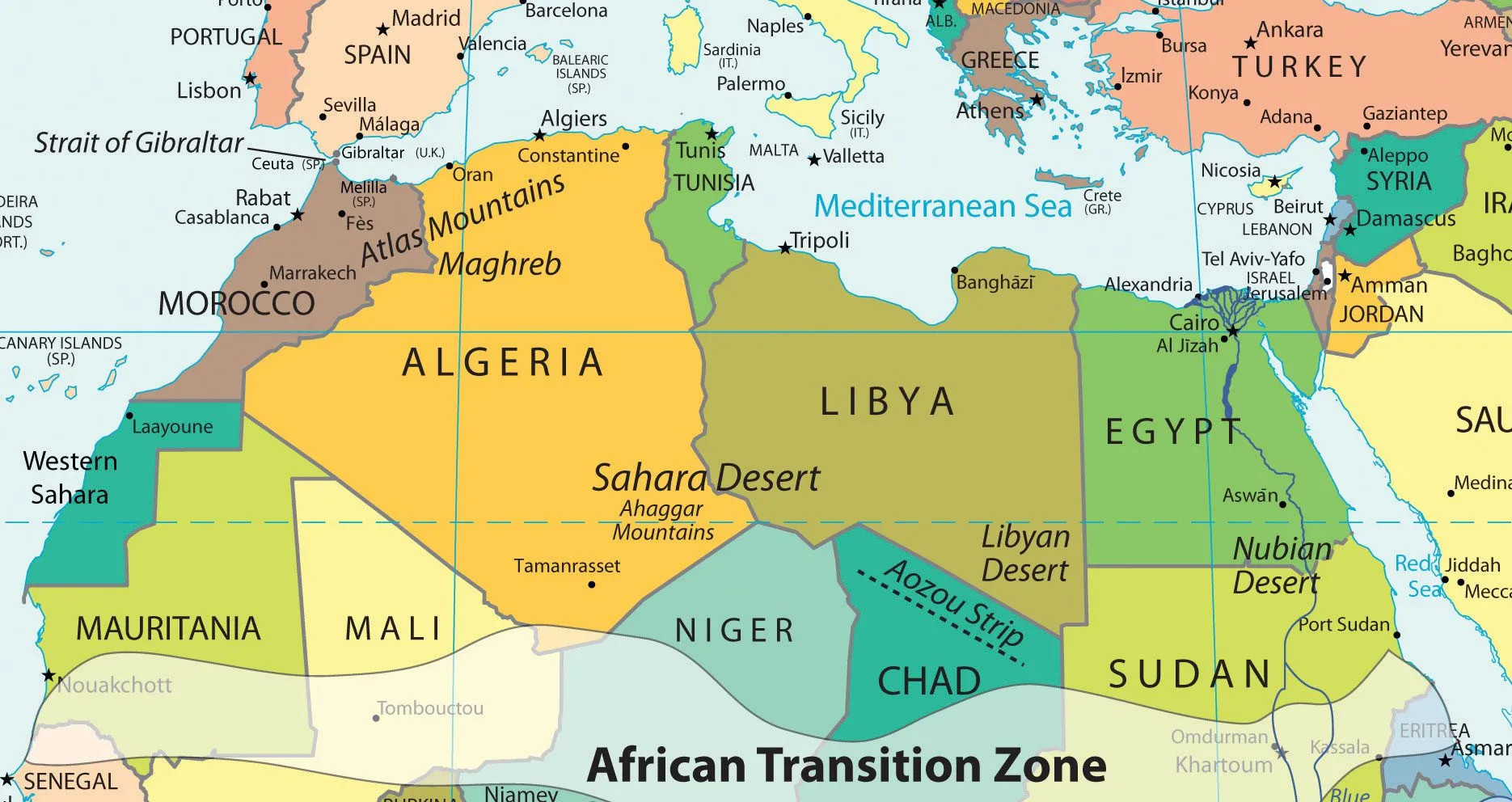
Between 1982 and 2005, Saudi Arabia spent over $75 billion with some estimates claiming that figure is closer to a $100 billion. Funding mosques, madrassas (Muslim schools), Islamic centres, scholarships, and religious education around the world. This was not philanthropy nor was it spreading a moderate form of Islam to help local citizenry of those countries which would have been virtuous. No, it was the slow and meticulous planning and international establishment of extremist infrastructure. Over 1,500 mosques, 200 Islamic colleges, 210 Islamic centres, and 2,000 schools formed a global network stretching “from Sudan to northern Pakistan”, in each, the version of Islam being taught was Wahhabism. A rigid, puritanical, and contemptuous form of Islamic traditions built over centuries of Sufi scholarship and indigenous synthesis.
Farah Pandith, a former US State Department official who visited nearly 100 countries studying this phenomenon, watched it happen in real time. In Kazakhstan and Timbuktu, in Burma and the Balkans, in Pakistan, Senegal, and Indonesia — she saw the same pattern: local Islamic traditions being displaced; local leaders who knew what Saudi Arabia was doing but were too desperate for school funding to say no. “They thought they could control the impact of Saudi ideology,” she wrote. “They were wrong.”
This is neo-colonialism in its most precise sense. Classic European colonialism imposed political authority and extracted economic resources. Saudi religious colonialism imposes interpretive authority and extracts something more intimate: the right of communities to understand their own faith on their own terms. As scholar Peter Mandaville’s landmark study Wahhabism and the World (Oxford University Press, 2022) documents, this project was geopolitically motivated from the start — a counter to Iranian influence, a tool of soft power, a means of building political leverage in Muslim-majority states.
When the Wahhabis arrived in Somalia, they found a population practising a centuries-old form of Sufi Islam — devotional, communal, deeply local. They set about dismantling it. Shrines were desecrated. Imams were replaced. Saudi aid built religious infrastructure that created, as one academic analysis put it, “ideological competition with local Islamist groups” and paved the way for harder-line movements that followed. For reference a 2013 report commisioned by the European Parliament identified Wahhabism as the main source of global terrorism.
In Yemen, Sudan, and Somalia, Saudi religious soft power has been followed by something harder and much more concrete. Money, weapons, and direct political intervention — each framed in the language of Sunni solidarity and stability.
Yemen has paid the most catastrophic price. Saudi Arabia’s military intervention in 2015 brought with it explicit ideological proxies. The Dar al-Hadith Institute in Dammaj, funded through Saudi networks since 1982, has spent decades Wahhabising northern Yemen’s religious culture as strategic preparation for exactly this kind of conflict. Saudi Arabia then supported the Salafi-tribal Giants Brigades, formed in 2015 as part of the Yemeni National Resistance fighting the Houthis. The mosques and the boMBS served the same strategic master. When Wadi’i returned to Yemen and established the Dammaj madrassa (Dar al-Hadith), he initially received significant support and assistance from the Muslim Brotherhood. The same Muslim Brotherhood which Saudi Arabia embargoed Qatar over in 2017.
Sudan is perhaps the bleakest case study in Saudi religious neo-colonialism, and it follows the tried and tested formula. It began with mosques, madrassas and then hospitals etc. Sudan had one of the most vibrant Sufi traditions in the Muslim world — devotional, communal, centuries-deep. Wahhabi petrodollars systematically dismantled it, replacing indigenous scholarship with a religious culture dependent on Riyadh for authority, funding, and legitimacy. Beneath that came economic extraction — millions of hectares of Sudan’s fertile Nile-fed land acquired by Gulf investors, its agricultural output oriented toward feeding Gulf populations rather than Sudanese ones.
When Sudan’s 2019 revolution produced a fragile civilian-led democratic transition, Saudi Arabia — alongside the UAE and Egypt — quietly undermined it, dealing with the generals and withholding condemnation when the military coup came in 2021. They called for “restraint” and kept the money flowing. Wahhabism came first, softening the ground. The money, the generals, and the guns followed. Throughout all of it, Saudi Arabia called it Islamic solidarity.
Sudan is perhaps the richest case study in Saudi religious neo-colonialism, and it follows a sequence that is by now familiar. It begins, as always, with the mosques. And beneath that, strategic interest: MBS’s Vision 2030 is built along the Red Sea coastline, NEOM sits on it, and Sudan’s Red Sea territory made Sudanese sovereignty a variable to be managed rather than a right to be respected. (European Council on Foreign Relations, 2025)
Somalia represents the longest-running Saudi religious project in the region. Decades of Wahhabi funding transformed the country’s religious culture, displacing its Sufi traditions, creating ideological conditions that the kingdom now officially opposes but cannot undo. Today Saudi Arabia funds the Somali federal government and presents itself as a force for stability. It also does not acknowledge its role in destabilising the country’s religious ecosystem in the first place.
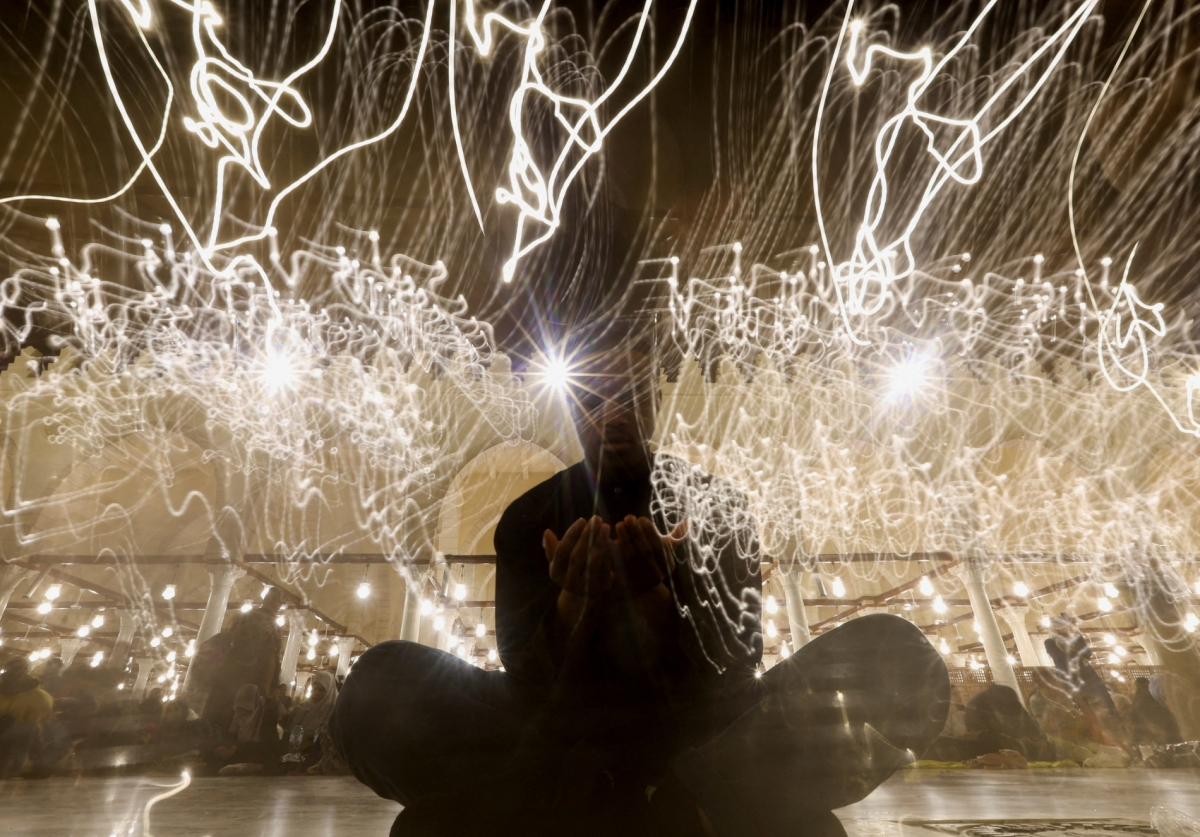
As we enter the holy month of Ramadan it’s time for self-reflection. You fast, and in that hunger you see yourself clearly. You pray, and in that silence, you confront who you really are. Every Muslim knows this. It is a major focus of the holy month. Strip away the distractions, the performances of daily life and face the truth.
So let us, in this spirit, look honestly at the man who governs in Islam’s name Mohammed bin Salman.
The House of Saud claims custodianship of Islam’s holiest sites. It presents itself to the 1.8 billion Muslims around the world as the guardian of the faith. It issues fatwas, funds mosques, prints Qurans, and trains imams in extremist Wahhabi doctrine. And it does all of this while, if the Epstein documents are any guide, its senior figures socialised with a convicted child sex trafficker, while its political elite pursued naked geopolitical interests in the bodies of Yemen, Sudan, and Somalia, and while the ruling class enforced on ordinary Saudis the very prohibitions, on alcohol, on free association, on free expression, that the privileged openly flouted themselves.
This is not a criticism of Islam. The faith which commands justice, protects the vulnerable, and holds the powerful accountable has been conscripted into service of those it most forcefully condemns. The words of the Quran are clear: “O you who believe, be persistently standing firm in justice, witnesses for Allah, even if it be against yourselves, or your parents, or your relatives” (4:135).
The question for this Ramadan is not whether to be Muslim. It is whether to be a Muslim who sees clearly — who can look at the photograph on Epstein’s wall, at the Kiswa cloth in his living room, at the ruins of Sana’a and the displacement camps of Darfur, and ask without flinching: who did this, and in whose name?
The fast is not for them. The fast is for people of conscience. And people of conscience, in this month of clarity, cannot look away from how elite of KSA are weaponizing Islam against its own people, the world, and in favour of the whims of MBS.
Leave a Reply