
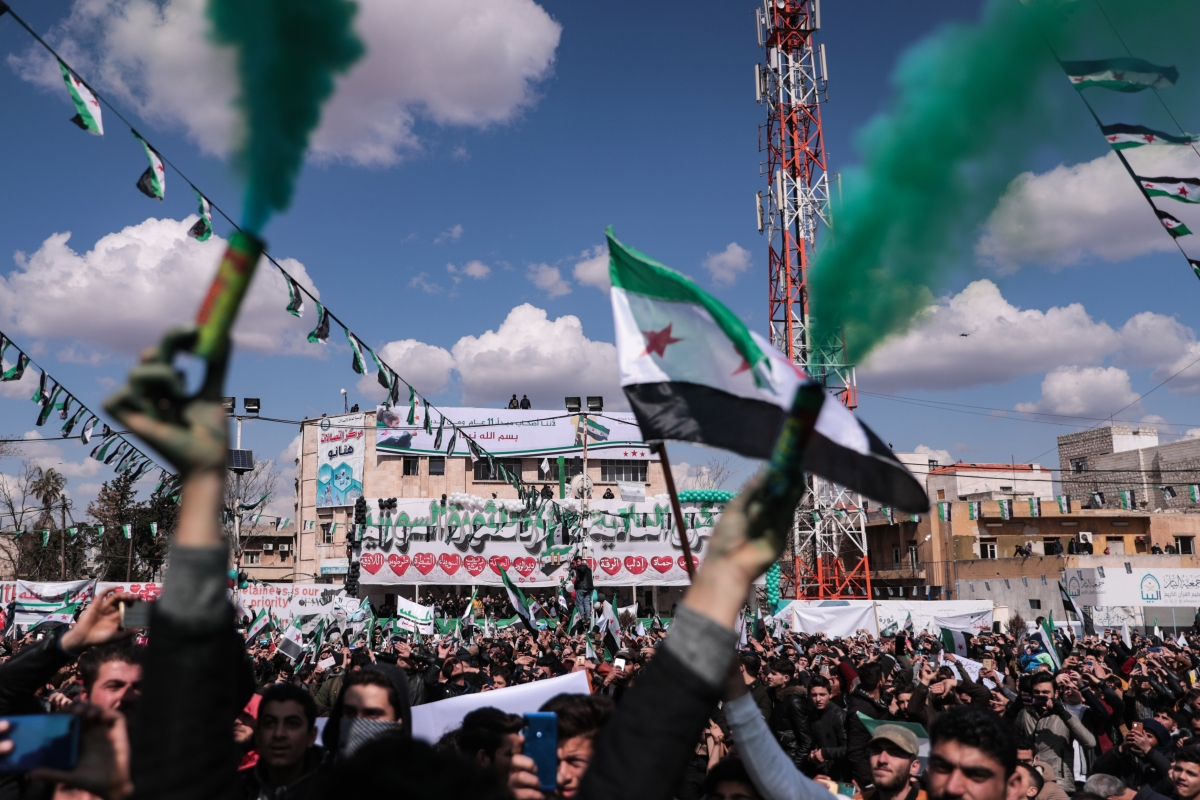
Syria entered 2026 without the constitutional architecture needed to hold its political transition together. More than a year after the fall of the Assad regime, the country is governed by a transitional declaration that concentrates authority,while offering limited mechanisms for oversight, minority representation, or judicial independence. The document signed by interim President Ahmad al-Sharaa in March 2025 was meant to stabilise the transition. Instead, it has become a source of friction among the communities and factions now competing to shape what comes next.
The declaration was drafted by a seven-member committee in approximately two weeks. It was not subject to meaningful public consultation, and several of Syria’s minority populations, including Kurds, Druze, and Alawites, have objected that it fails to reflect the country’s demographic complexity. In Qamishli, hundreds protested the document within days of its ratification. Druze spiritual leader Hikmat al-Hijri went further, characterising the transitional government as extremist and rejecting the possibility of consensus under its leadership.
A Hyper-Presidential Model in a Fractured State
The constitutional declaration establishes a rigid presidential system. Al-Sharaa holds authority over cabinet appointments, military command, and judicial nominations, with no provision for parliamentary impeachment or meaningful legislative checks. The People’s Assembly, created as an interim legislature, has no power to approve or remove ministers. Human Rights Watch warned in March 2025 that the declaration risks consolidating executive control at the expense of fundamental freedoms.
Constitutional experts have drawn unfavourable comparisons with Syria’s previous frameworks. The 1973 and 2012 constitutions were both hyper-presidential instruments designed to serve authoritarian rule. The 2025 declaration removes some powers, such as the ability to dissolve parliament, but retains the core structure. Analysts at the Arab Reform Initiative have argued that Syria’s current situation, with half its population displaced, its territory divided, and political parties lacking experience in negotiation, demands a fundamentally different model of governance.
The five-year transitional period is not inherently problematic. Rushing into permanent constitutional arrangements, as Egypt and Libya did after 2011, produced weak documents that failed to hold. The concern is that the current framework provides no credible pathway from interim declaration to permanent constitution. The Supreme Constitutional Court remains unstaffed. The drafting committee for a permanent constitution has not been named. And the president retains the power to amend the declaration unilaterally at any time.
The Kurdish Question and Eastern Syria
The constitutional gap has practical consequences in eastern Syria. In January 2026, the transitional government launched a military offensive against areas held by the Syrian Democratic Forces and the Autonomous Administration of North and East Syria. Under agreements reached after the fighting, the government and local authorities are now pursuing what has been described as a phased integration of military and administrative forces.
The SDF had signed an integration agreement with Damascus in March 2025, but implementation stalled as the year progressed. Turkey’s opposition to Kurdish autonomy and the transitional government’s refusal to accept any form of federation limited the space for negotiation. The US special envoy for Syria stated in January 2026 that the original purpose of the SDF as an anti-ISIS force had largely expired, signalling reduced American support for the group’s political ambitions.
Without constitutional protections for minority governance, the integration process risks becoming absorption. Kurdish, Druze, and other minority populations have limited reason to trust a framework that offers no enforceable guarantees of rights or representation.
What Comes Next
The most pressing test in 2026 will be the appointment of the remaining third of the People’s Assembly by al-Sharaa, and the Assembly’s subsequent work on drafting a permanent constitution. The Atlantic Council noted in January 2026 that the composition of this appointed cohort and the content of the constitution will be closely judged and must reflect a commitment to equal rights under a civil state.
Transitional justice also remains stalled. Prosecuting regime-era officials for war crimes requires legal codes that the current framework does not contain. Until a permanent constitution establishes those codes, accountability will remain aspirational.
Syria has a narrow window. The transitional period could provide space for genuine institution-building if the government demonstrates willingness to share power and accept external oversight. If, instead, the constitutional declaration becomes a tool for consolidating authority under a single faction, Syria risks reproducing the governance failures that defined the decades before 2024.




Leave a Reply