
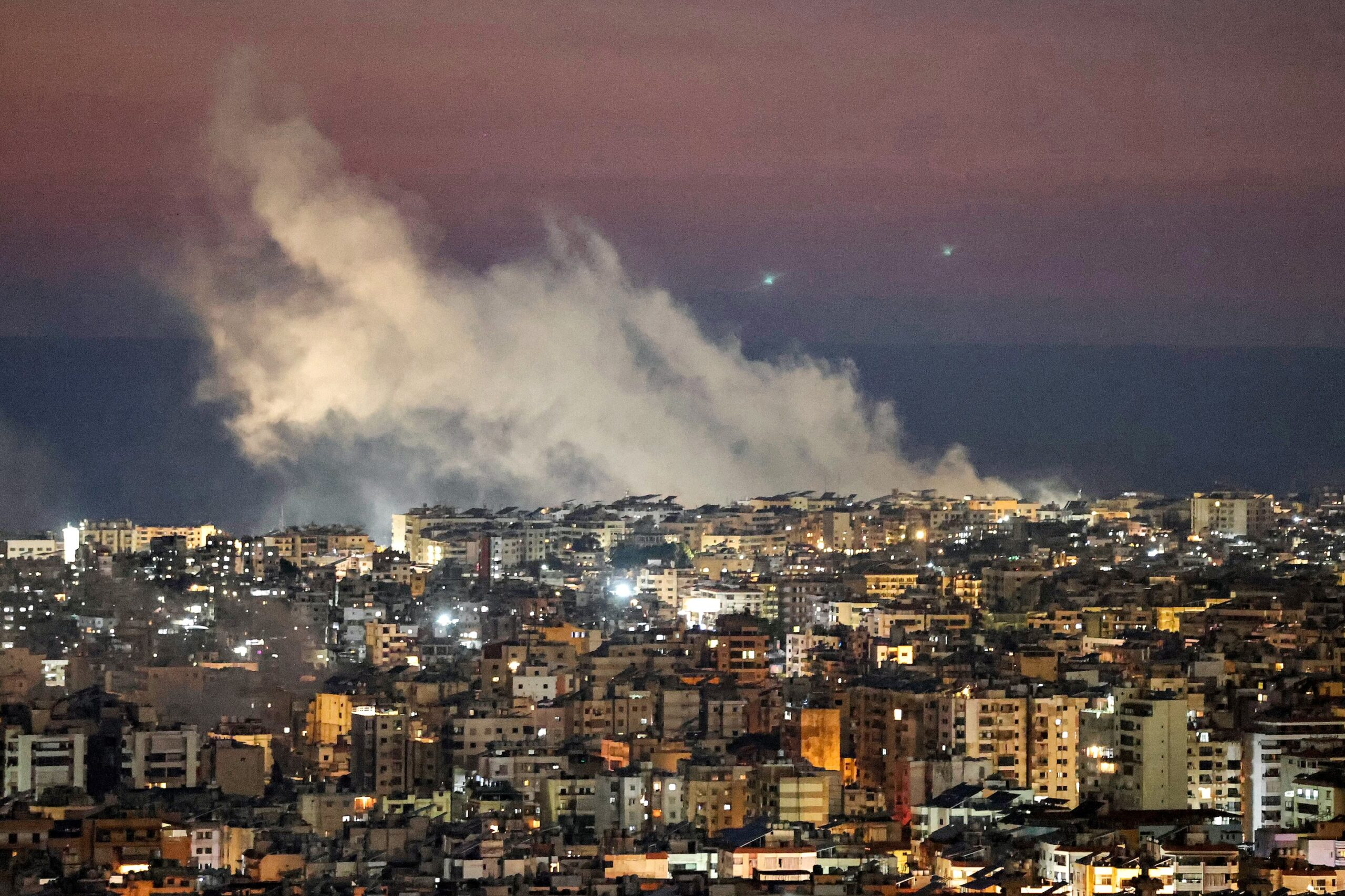
On Monday, March 2, Lebanon got pulled into a regional war that many in the country had hoped to avoid. This explainer lays out how that happened, what has unfolded, what the impact on the ground has been, and how the Lebanese government has responded.
On Saturday, February 28, 2026, the United States and Israel launched a massive military operation against Iran. In the days prior, murmurs of a potential attack had been floated and the Pentagon had built up a notably large force of American warships and aircraft carriers. Meanwhile, U.S.-Iran nuclear talks continued. In fact, on the day prior to the operation, one key mediator, Omani Foreign Minister Badr bin Hamad Al Busaidi expressed confidence that a “peace deal is within our reach.”
As the attack kicked off, U.S. President Donald Trump made public remarks claiming that Iran had “attempted to rebuild their nuclear program,” pledging, “They will never have a nuclear weapon.” Introducing a regime change component to the war which he has since explicitly adopted, he directed an additional message to the Iranian people: “When we are finished, take over your government. It will be yours to take. This will be probably your only chance for generations.”
In response, Iran launched counterattacks, targeting Israel and a number of neighboring countries who are either hosts of U.S. military installations or close U.S. partners. In the early hours of Monday, Hezbollah launched an attack on a military site in Haifa, spreading the conflict even further.
How did Lebanon get pulled into the war?
Following hours of U.S. and Israeli strikes on Iran on Saturday, Israel announced the killing of Iran’s Supreme Leader Ayatollah Ali Khamenei, who was revered as a spiritual guide by some Shia Muslims and was at the helm of Iran’s political power structure for almost four decades. He had also been at the heart of devastating abuses in Iran and around the region, including the targeting and killing of Iranian protesters and support for the brutal Assad regime. On Sunday, Hezbollah issued a statement describing the U.S. and Israel’s killing of Khamenei as “the height of criminality,” referring to him as “our guardian, our leader, the leader of the Nation, Imam Khamenei.” They pledged to “fulfill [their] duty in confronting aggression.”
In a self-described act of retaliation for Khamenei’s killing, on early Monday morning, Hezbollah launched a rocket and drone attack against a military site in Haifa, marking the first time that Hezbollah had attacked Israel since the November 2024 ceasefire. Israel has since responded with sweeping airstrikes in South Lebanon, Dahieh, and Beqaa, which are still ongoing at the time of writing. Israel has also issued evacuation warnings for over 50 villages in southern and eastern Lebanon, leading to a mass exodus of civilians seeking to flee from the site of potential strikes. On March 2, Lebanon’s Ministry of Health stated that the death toll had climbed to 52, with 154 wounded.
Prior to this escalation, Israeli military strikes on South Lebanon and the Beqaa had continued on an almost daily basis since the November 2024 ceasefire; leading to the death of 127 civilians as of November 2025 and the damage and destruction of 10,000 buildings.
How has the Lebanese government responded?
Within hours of Hezbollah’s rocket and drone attack, Lebanese President Joseph Aoun rejected the use of Lebanon as a “platform for proxy wars” and Prime Minister Nawaf Salam called the firing of rockets “irresponsible.” The Prime Minister said that his government would not “allow dragging the country into new adventures.”
Following an emergency session at the Presidential Palace, Salam made a number of significant public remarks which reiterate the leadership of the Lebanese government on this file, its unequivocal rejection of Hezbollah’s attacks, and its commitment to a full disarmament process. Specifically, Salam has:
- Announced a ban on all “security and military activities by Hezbollah,” deeming them “illegal” and demanding that Hezbollah hand over its weapons to the Lebanese state;
- Directed military and security agencies to implement today’s order on Hezbollah, to prevent any military operation or the launching of any missiles and drones from Lebanese territory, and to arrest those violating this order;
- Directed the army “to immediately and decisively” implement the plan presented on February 16, 2026 (considered phase 2” of the Hezbollah disarmament plan, following the successful completion of phase 1 in January 2026), “concerning the confiscation of weapons north of the Litani River, using all means necessary to ensure its implementation”;
- Called on the guarantor states of the ceasefire (the United States and France) “to obtain a clear and final commitment from the Israeli side to cease all attacks on all Lebanese territory” and requested that the Ministry of Foreign Affairs and Emigrants engage with the international community to “stop Israeli aggression”; and
- Directed the Ministry of Social Affairs to secure shelter for those displaced and to provide them with food and essential supplies.
According to Lebanese media, “a source close to the Lebanese government reported that two ministers from the Amal Movement, Hezbollah’s fellow Shia party and key ally, and one minister from the group itself approved the cabinet’s decision.”
Concerning providing support to the displaced populations, the Minister of Social Affairs Haneen Sayed has reported that authorities have opened 171 shelters so far, 27 of them in Beirut and 34 in the south. Of these shelters, 76 of them have reached full capacity, hosting 29,000 officially registered displaced persons, representing more than 5,400 families. Organizations on the ground state that the total number of those displaced is much higher than the number of those registered and that it will continue to rise.
In the days to come, all eyes will be on the extent of Israeli attacks and their impact on civilians on the ground, how Hezbollah and other non-state actors will engage going forward, and the steps that the Lebanese government will take to implement the Prime Minister’s critical announcement. Meanwhile, the people of Lebanon face the harms of yet another devastating conflict that comes to a country that has not yet had the chance to rebuild and recoup.

اترك تعليقاً