
In May, Pakistani C-130s began landing at Saudi air bases carrying pieces of a Chinese-made HQ-9 air defence systems. Eight thousand Pakistani troops then quickly followed, along with approximately sixteen JF-17 fighter jets and two squadrons of drones. The deployment, confirmed by Pakistani security officials, was described as a “substantial, combat-capable force intended to support Saudi Arabia’s military if the Kingdom comes under further attack.” The phrasing, however, is quite ironic as the Kingdom had already come under attack. Saudi Arabia had already been hit. Iranian missiles had struck oil infrastructure and military sites across the country in the weeks following the February 28 escalation. And MBS’s response was not to scramble his own air force but instead MBS decided to invoke the 2025 Saudi-Pakistani mutual defence pact and ask someone else to do the job.
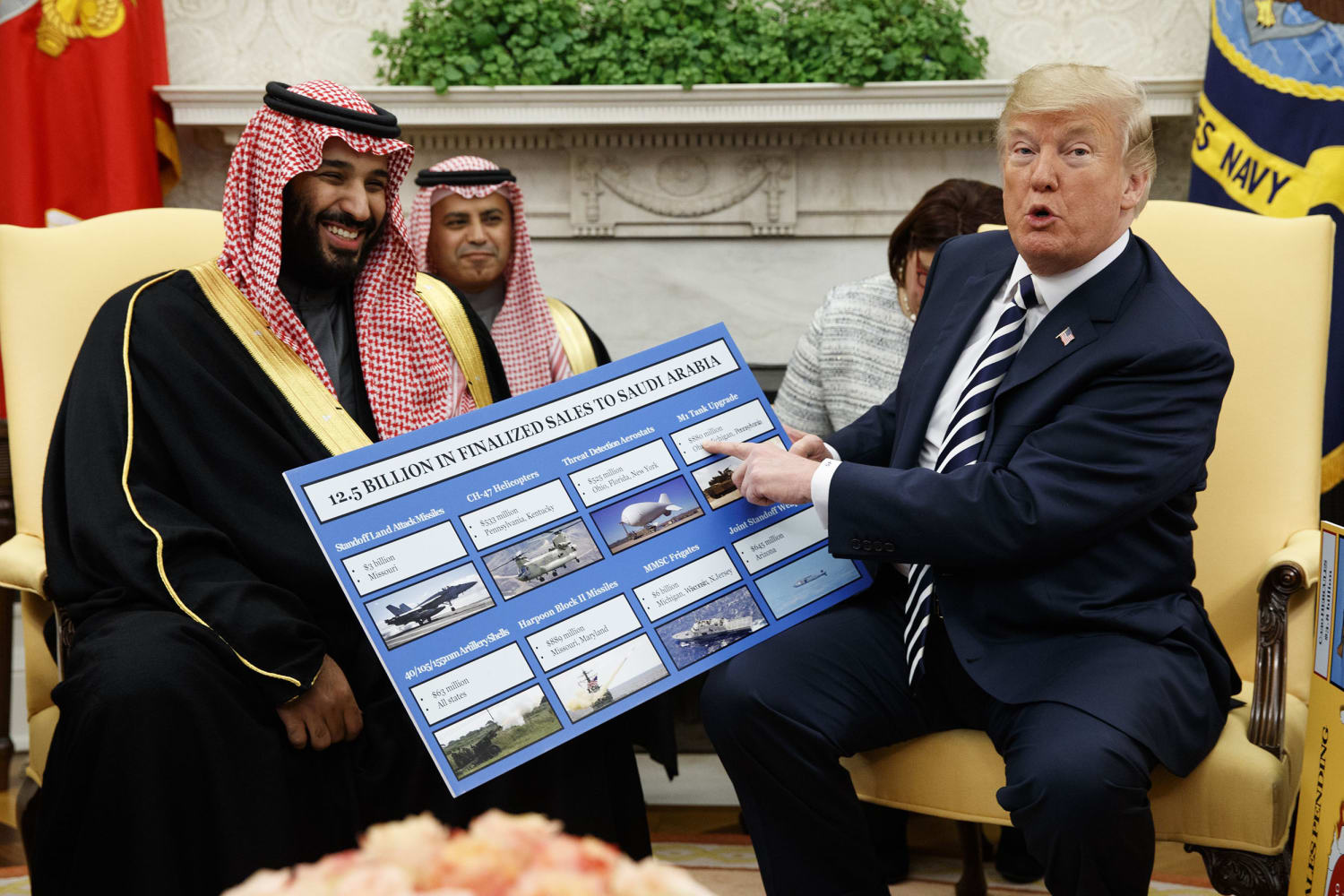
Saudi Arabia allocated $78 billion for defence in 2025. That figure makes the kingdom of Saudi Arabia the fifth-largest military spender, right after the United States, China, Russia, and India. Over the past decade, Riyadh has imported roughly eighty percent of its arms from the United State, having spent billions on F-15s, Patriot batteries, THAAD systems, and precision-guided munitions among other advanced systems. MBS personally oversaw the 2017 arms mega-deal with Washington, standing beside Trump for the cameras, with $110 billion of spending announced. The jets are currently parked on the tarmac at King Khalid Air Base and King Fahd Air Base and not used in combat or defensive operations.
Yet when the time came to put all that hardware to the test, the Kingdom and its armed services failed to rise to the occasion and defend its people. Instead, they had to call Islamabad for urgent help and essentially treat them as mercenaries.
The question circulating inside Gulf capitals and most importantly inside Saudi Arabia itself, is simple enough: why spend seventy-eight billion dollars a year on all that American hardware and US-led training programs and embedded advisors at Saudi bases if MBS and the Kingdom if it was not going to be put to use at a time of need?
The answer to that question lies in how the structure of the Saudi military is made up, and it is nothing new. The Kingdom’s armed forces have never been designed primarily to fight wars but instead they have been designed to prevent coups.
The Saudi Arabian National Guard, also known as the SANG, exists as a separate military organization from the regular armed forces, reporting directly and only to the King, not the Ministry of Defence (for reference the minister of defence in Saudi Arabia is headed and controlled by MBS). Its ranks are drawn from the Najdi tribes who have historically been loyal to the House of Saud, recruited specifically for regime protection. The regular officer corps, meanwhile, have historically been dominated by the Najd aristocracy, where promotions are governed less by operational competence than by tribal affiliation and proximity to the royal family. US military analysts have in multiple instances noted that tribal factions within the Saudi military “don’t work side by side together very well, they don’t trust one another, and that’s going to hurt the unit combat ferocity.”
Yemen proved this. When MBS launched his aerial campaign in 2015, the Royal Saudi Air Force, despite having total air superiority, American-built aircrafts, and precision-guided munitions could neither achieve their objectives nor respect international war legal restrictions on targeting of civilians. Pilots bombed from extreme altitudes to avoid ground fire, producing catastrophic inaccuracy. With the Saudi’s most famously hitting a funeral in Sana’a, killing over 140 people, and striking their own allied militants twice in a single week. The Saudi air force’s then attempted to procure JDAM kits to convert their dumb bombs into guided weapons which in itself is an admission that its pilots could not reliably hit targets. It is important to note that these operations were not complex air defence operations nor where they performed in an environment where the pilots were at risk. The Houthis had no air force. And still the Saudi Air Force, the showpiece of MBS’s military spending, performed like a force that had bought equipment because it looked pretty rather and wanted to show off its appearance but never seriously intended to use it.
Now place the same institution against Iran, a country with ballistic missile capability, layered air defences, and combat-hardened commanders from Syria, Iraq, and Lebanon. The distance between the Saudi Air Force’s actual operational readiness and the threat it faces is not a gap but rather a canyon. Pakistani JF-17s are not superior aircraft but they come with Pakistani pilots, who have combat experience, institutional discipline, and a military culture that relies on competence rather than bloodline. MBS called Islamabad because Pakistan not only has better pilots but they are combat literate.
And then there is the Yemen scandal. Rumours claim that MBS was so worried about theYemenis that he decided it was better to buy them off rather fighting them or being at the mercy of their attacks.
Since 2023, reports have circulated saying that Saudi Arabia, under an Omani-mediated “Road Map” agreement with the Houthis, has been transferring tens of millions of dollars every few months to the Houthi via Yemen’s central bank. Riyadh committed to covering civil servant salaries across all Yemeni regions at a rate of up to $1 billion per year. In February 2026, weeks before Iranian missiles hit Saudi, MBS announced an additional $346.6 million aid package for Yemen. The total Saudi outlay to keep the Houthis quiet since the Road Map began — salary transfers, budget support, humanitarian pledges — likely exceeds the $3 billion mark. With some estimates inside the Gulf intelligence community putting that figure at 30-40% higher, accounting for payments routed through intermediaries that do not appear in official aid announcements.
MBS spent a decade bombing Yemen, killed tens of thousands of civillians, created the world’s largest humanitarian crisis, and then, when the Houthis proved hard to break, started paying them not to shoot back. MBS could not defeat a militia that has no navy, no air force, and no functioning state behind it. Let’s call it what it is, the Saudi’s are paying for protection from the very war they instigated and the genius behind it now has to deal with Iran.
When you zoom out and analyse the current economic situation the Saudi’s find themselves in it becomes overwhelmingly obvious that MBS bought more than he could handle. The Kingdom’s Q1 2026 budget deficit amounted to $33.5 billion, the largest quarterly shortfall in Saudi history. Oil revenues keep falling while the breakeven price sits at $88 per barrel and Brent trades at $61. Shipping insurance through Hormuz is up 2,000 percent. NEOM contracts cancelled — $6 billion in March alone. PIF cuts of sixty percent across more than a hundred companies. The Line halted. Vision 2030, the grand project that was supposed to make all of this irrelevant — the future economy that would transcend oil, attract global investment, turn the desert into a tech hub — sits gutted by the war its architect helped make possible and cannot end.
As this publication has documented, MBS chairs the PIF board, chairs the council that oversees the board, and appoints every member. The fund’s $8 billion giga-project write-down, the contract cancellations, the layoffs — all of it traces back to one decision-maker who cannot be questioned, cannot be overruled, and apparently cannot be told that an army built on tribal patronage and American equipment it barely knows how to operate is not the same thing as a military.
Saudi citizens are watching Pakistani pilots patrol their skies. They are watching $78 billion a year buy nothing that works when it matters. They are watching a Crown Prince who promised them a future beyond oil, while presiding over the collapse of the vision that was supposed to deliver it, while quietly writing checks to the Yemeni militia he once promised to destroy. The social contract that kept the Kingdom stable for decades — subsidies and silence, wealth in exchange for obedience — depends on the wealth part holding and this is starting to crumble.
Leave a Reply