
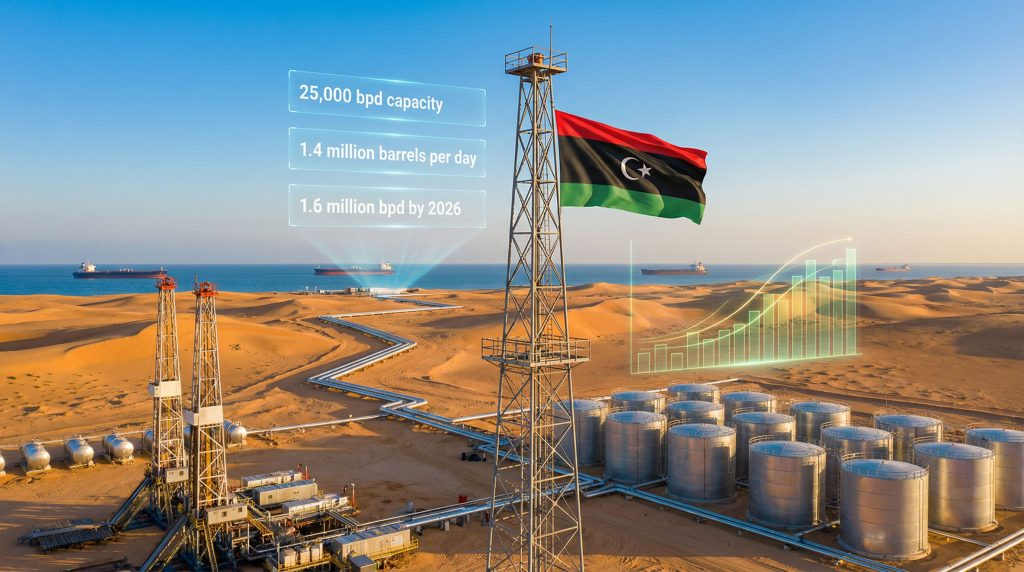
Libya’s oil sector has staged a remarkable recovery in 2025, with production climbing back toward 1.3 million barrels per day, near pre-civil war levels. For a country that has endured more than a decade of armed conflict, institutional fragmentation and periodic infrastructure shutdowns, the rebound represents a significant achievement. It also underscores the precariousness of an economy that depends almost entirely on a single commodity controlled by competing political factions with fundamentally different visions of the country’s future.
The Central Bank Crisis and Its Aftermath
The most recent disruption to Libya’s oil output came in the second half of 2024, when the internationally recognised Government of National Unity in Tripoli moved to replace the governor and board of the Central Bank. Forces aligned with the eastern-based Libyan National Army, led by Khalifa Haftar, responded by ordering a shutdown of oil operations in areas under their control. Production collapsed from over 1.2 million barrels per day to under 450,000 within weeks.
UN mediators brokered a settlement in late September 2024, and production resumed within days. The episode illustrated a dynamic that has defined Libya’s post-Gaddafi era: oil infrastructure and export revenues are routinely weaponised as leverage in political disputes between east and west. According to the US Energy Information Administration, Libya holds Africa’s largest proven oil reserves at 48 billion barrels, yet political conflicts and militia attacks on energy infrastructure have limited capital investment and constrained exploration since 2011.
The Licensing Round: Ambition Meets Reality
In March 2025, the National Oil Corporation launched Libya’s first oil licensing round in more than 17 years, offering 22 onshore and offshore blocks. The round attracted significant initial interest, with 44 companies and one consortium submitting applications. By mid-2025, 37 entities had been pre-qualified, including major international operators such as Eni, TotalEnergies, BP, Repsol, OMV, ExxonMobil and Chevron, alongside state-backed firms from China, Russia, India, Turkey and Qatar.
The breadth of participation signalled renewed willingness among international investors to re-engage with Libya, encouraged by recovering production and relative stability following the October 2020 ceasefire. The UK Home Office’s 2025 country assessment noted that while acts of violence continue to occur, the security situation has improved considerably since the ceasefire, with a marked reduction in combatant and civilian fatalities. The NOC has set ambitious targets of increasing oil production to 2 million barrels per day and raising gas output substantially by 2030.
The Dual Governance Problem
Any assessment of Libya’s energy prospects must contend with the country’s fractured political geography. The GNU in Tripoli retains the legal authority to award contracts and access international financial systems. Many producing assets, particularly in the Sirte Basin, are physically secured by eastern forces aligned with Haftar’s LNA. Investors sign contracts with Tripoli for legal validity while relying on security arrangements with eastern authorities to ensure uninterrupted operations.
This dual structure has become an operational reality rather than a temporary anomaly. The UN Security Council has repeatedly warned of the growing risk that Libya could become a battlefield for proxy wars, with external interference from multiple state and non-state actors complicating domestic reconciliation. The planned opening of exploration areas must be carried out transparently and in a manner that benefits the Libyan population as a whole, yet the absence of unified governance makes equitable revenue distribution extraordinarily difficult.
European Energy Security and Libyan Supply
Europe’s interest in Libyan hydrocarbons has intensified since 2022, as the continent has sought to diversify away from Russian energy supplies. Libya’s geographic proximity to southern European markets, combined with its substantial reserves of both crude oil and natural gas, positions it as a potentially important alternative supplier. Eni’s large-scale offshore gas project in Zone D, which aims to produce up to 750 million standard cubic feet per day from 2026, and ExxonMobil’s 10-year exploration memorandum reflect this strategic calculus.
The challenge for European policymakers and energy companies alike is that Libyan supply has historically been among the most volatile in the world. Production swings of hundreds of thousands of barrels per day can occur within weeks, driven by armed confrontations, labour disputes, budget constraints and infrastructure failures. Although Libya is an OPEC member, it remains exempt from the group’s production agreements precisely because of this instability.
التوقعات
The trajectory of Libya’s energy sector over the remainder of 2025 and into 2026 will depend almost entirely on the durability of the current political equilibrium. If the fragile truce holds and the licensing round proceeds to contract finalisation, the country could see incremental gains in production capacity and begin to attract the sustained investment needed to develop its reserves. If political tensions escalate, as they have repeatedly since 2011, another oil shutdown could materialise rapidly and with little warning. For Libya, the distance between potential and realisation remains defined by the same unresolved question: whether competing factions can agree on how to share the revenues generated by the country’s most valuable asset. Until that question finds a durable answer, every barrel of Libyan oil will carry a political risk premium that no licensing round can eliminate.


اترك تعليقاً