
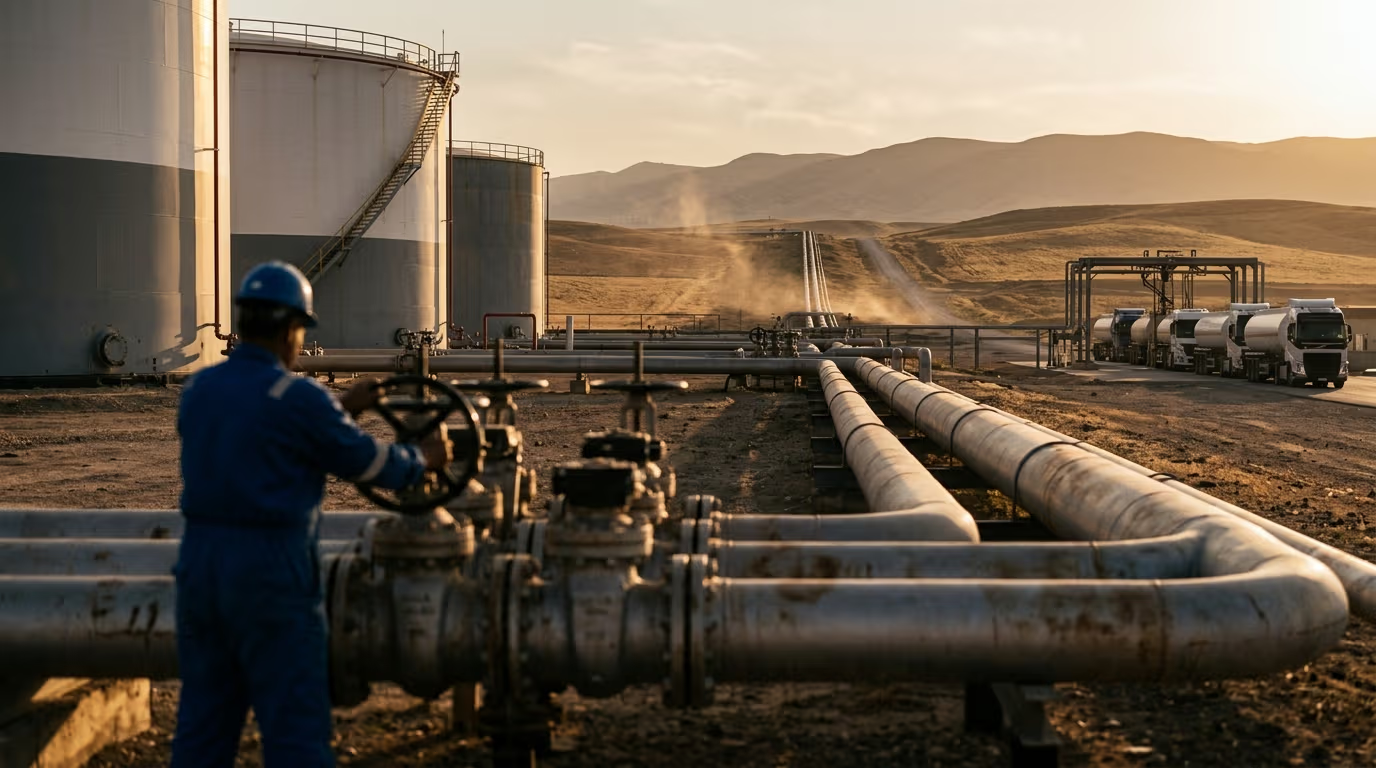
For more than two years, the Kirkuk-Ceyhan pipeline linking northern Iraq to Turkey’s Mediterranean export terminal has sat idle. The shutdown, which began in March 2023 after an international arbitration court ruled that Turkey had violated the 1972 pipeline treaty by permitting independent Kurdish oil exports, has cost Iraq and the Kurdistan Region an estimated $35 billion in lost revenues. The dispute between Baghdad and Erbil over control of oil resources, sovereignty over contracts, and the distribution of export revenues is among the most economically destructive internal conflicts in the MENA region, and recent months have seen a dangerous escalation that threatens to make resolution even more difficult.
The Salary Crisis and Fiscal Retaliation
In May 2025, Iraq’s Finance Minister informed the Kurdistan Regional Government that no further budget disbursements would be made, citing Erbil’s alleged exhaustion of its allocation under the 2025 federal budget. The decision plunged the KRG into a deep fiscal crisis. Civil servants’ salaries have gone unpaid since April, with cumulative arrears stretching back years. According to Human Rights Watch, Baghdad has intermittently withheld Erbil’s share of the federal budget since 2014, using payments as leverage. Over the past decade, teachers have been denied 16 monthly salaries outright and only partially paid for 44 months, triggering repeated strikes that left hundreds of thousands of students without schooling.
The salary crisis extends beyond education. Healthcare workers have repeatedly gone on strike over non-payment, restricting services to emergency care. Many physicians have migrated to private practice, reducing the capacity of public hospitals. The combination of budget withholding and pipeline closure has created a compounding effect: the KRG cannot fund public services, while the revenue that would support those services remains inaccessible.
Drone Strikes on Energy Infrastructure
In mid-July 2025, drone strikes by unidentified groups hit five oil fields in the Kurdistan Region over a three-day period, taking approximately 220,000 barrels per day of production offline and cutting the region’s total output by 70 per cent. The New Lines Institute reported that the Khor Mor gas field, which provides feedstock for the majority of Kurdistan’s power generation, has been struck by drones at least nine times since 2023. No group claimed responsibility, but senior KRG officials attributed the attacks to Iranian-backed militias operating within Iraq. Baghdad ordered an investigation but has not published results from any previous incidents.
The attacks represent a qualitative escalation. Targeting energy infrastructure in a region that depends on oil and gas revenues for virtually all public services carries consequences that extend far beyond the immediate production losses. The strikes occurred against the backdrop of a broader pattern: the Kurdistan Region has absorbed hundreds of drone and missile attacks in recent years, many linked to Iranian proxies, without meaningful accountability from the federal government.
The Pipeline Impasse
Negotiations to reopen the Kirkuk-Ceyhan pipeline have repeatedly stalled. Baghdad insists that all Kurdish oil must be marketed through SOMO, the federal oil marketing organisation, restoring central government control over exports. The KRG has conditioned its cooperation on a broader set of demands: the easing of customs restrictions, improved dollar liquidity for Kurdish banks, access to the official exchange rate, and an end to militia attacks on energy infrastructure. The مجلس الأطلسي has observed that this linkage has created a deadlock, with each side treating the pipeline as leverage in disputes that extend well beyond oil policy.
The July 2025 cabinet agreement, brokered under pressure from Washington, offered a framework: Kurdistan would deliver crude to SOMO for export, receiving $16 per barrel to cover production and transport costs, while Baghdad would resume salary payments. Whether this framework can translate into sustained oil flows remains deeply uncertain. International oil companies operating in the region, which are owed approximately $1 billion in back payments, have expressed dissatisfaction with the $16 price and seek contractual protections that the current arrangement does not guarantee.
التوقعات
The coming months present a narrow window for de-escalation. Iraq’s November 2025 parliamentary elections will dominate the political calendar, and both Baghdad and Erbil have incentives to demonstrate competence to their respective electorates. A functioning pipeline would provide tangible economic benefits: resumed export revenues, salary payments and a signal of institutional capacity. The obstacles, though, are formidable. Militia violence against Kurdish energy infrastructure continues without consequence. The fundamental constitutional dispute over who controls natural resources in a federal Iraq has not been resolved since 2003. And the broader regional environment, shaped by the aftermath of the Twelve-Day War and continued instability across multiple MENA states, provides little external pressure toward compromise. For Iraq, the pipeline is both a symptom and a symbol: a country with vast hydrocarbon wealth that cannot move its own petroleum because its political class has yet to agree on how that wealth should be shared.


اترك تعليقاً